Most people who have been in a car accident at highway speed do not fully appreciate what their body just experienced. This is not a failure of intelligence. It is a predictable consequence of how human beings perceive speed, and it has real consequences for how whiplash injuries are understood, assessed, and taken seriously by everyone involved.
The physics are clarifying.
What Newton’s Laws Tell Us About Road Speed
Using Newton’s laws of motion, we can calculate the impact speed of an object in free fall from a given height. This gives us a useful comparison point, because most people have an intuitive and healthy fear of falling from height that they do not apply to driving.
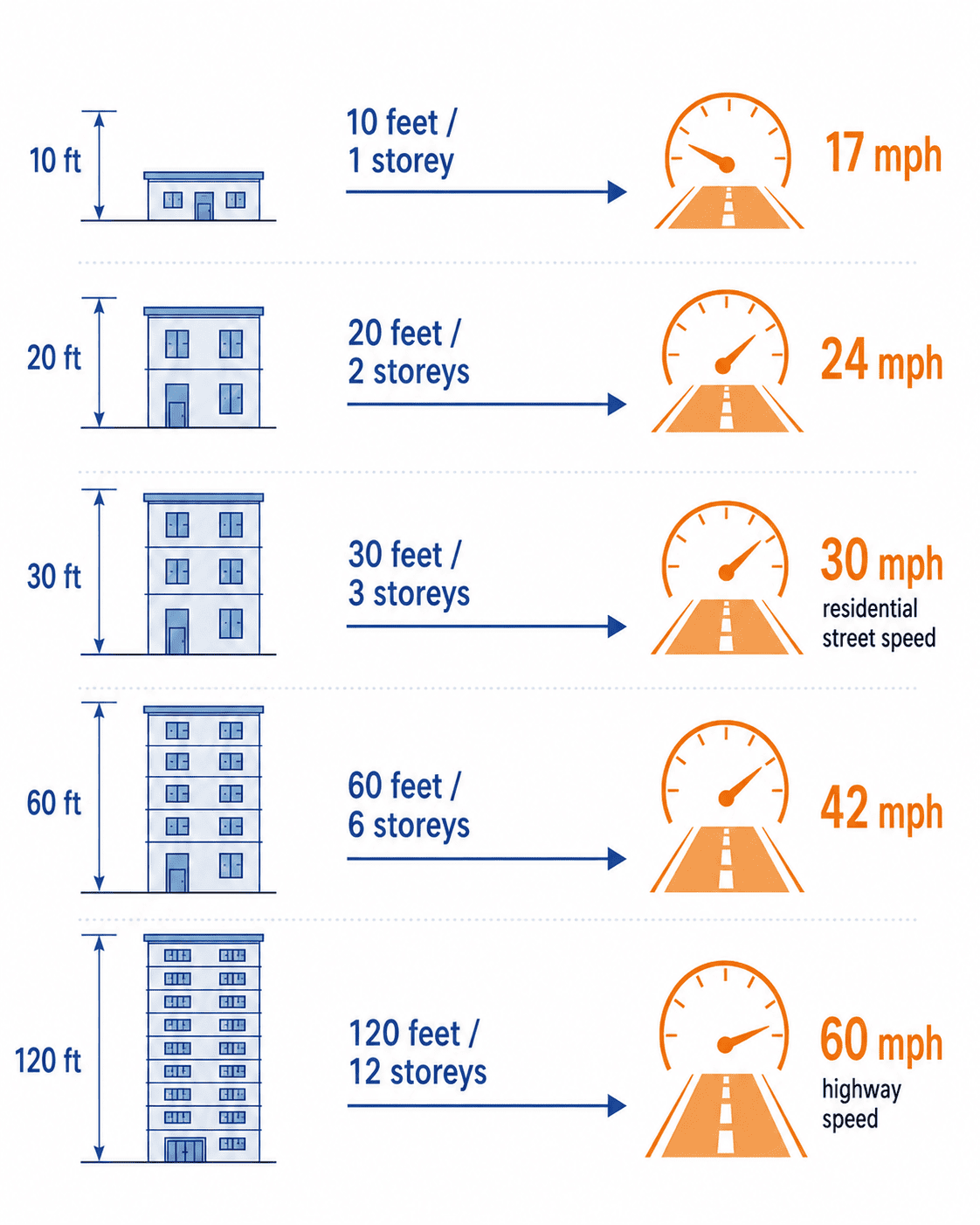
A free fall from 10 feet, the height of a single-storey building, produces an impact speed of approximately 17 mph. A fall from 20 feet, two storeys, produces approximately 24 mph. A fall from 30 feet, three storeys, produces approximately 30 mph. This is roughly the speed of driving through a residential neighbourhood to drop children at school.
A fall from 120 feet, equivalent to a 12-storey building, produces an impact speed of approximately 60 mph. This is a standard North American highway speed.
The weight of the object does not change these numbers. Whether the falling object weighs 10 pounds or 2,000 pounds, the impact velocity from a given height is the same. Mass affects the force involved, not the velocity calculation.
The comparison needs one important qualification. What injures the body is not speed alone but how abruptly that speed changes. A person falling 120 feet onto concrete stops in a fraction of an inch. A vehicle at highway speed has crumple zones, restraints, and a seat, all of which extend the time over which deceleration occurs and reduce the peak force reaching the occupant. The fall comparison describes the energy in the system, not the force delivered to any particular body.
Even with that qualification, the point stands. Most people would not describe falling from a twelve-storey building as a minor event, and would not expect to walk away uninjured. The same energies are present in routine highway driving, and the collisions that release them are routinely described as minor.
The Number That Actually Matters
In whiplash biomechanics, the measurement that best predicts injury is not how fast either vehicle was travelling. It is delta-v: the change in velocity that the occupant’s body undergoes during the impact.
These are different numbers, and the difference matters. A driver travelling at 60 mph who is struck from behind by a vehicle travelling at 70 mph experiences a delta-v of roughly 10 mph, not 60. A driver travelling at 30 mph who strikes a stationary concrete barrier experiences a delta-v of 30 mph. The second collision is far more severe despite the lower road speed.
This is why accident reconstruction focuses on delta-v when evaluating injury thresholds, and why recent work on low-speed rear-end collisions concentrates on estimating it accurately. That research examined 97 crash tests at or below 21 km/h, roughly 13 mph, which is the range in which whiplash injuries are commonly studied. Delta-v in the collisions that produce most whiplash claims is considerably lower than highway travel speed.
None of this makes those collisions harmless. It clarifies what should be asked about them. A useful question after a collision is not how fast were you going, but how abruptly did your body change speed, and in what direction.
Why We Misjudge the Risk
There are several reasons why drivers and passengers consistently underestimate the forces involved in road travel, and understanding these reasons matters for how we approach injury assessment after accidents.
The first is a perceptual phenomenon commonly called velocitization. When a driver or passenger maintains a consistent speed over time, the nervous system adapts and begins to perceive that speed as slower than it is. Highway driving at 60 mph genuinely feels slower after 20 minutes than it did at the on-ramp. The speed has not changed. The perception has. This is a well-described effect of sustained velocity on sensory adaptation.
I experienced this directly about two decades ago in Las Vegas, riding as a passenger in a two-seat open-wheel race car at 200 mph around a speedway oval. At first the speed was overwhelming. Within a few laps the sensation had normalized to the point where it felt almost routine. That same evening I developed significant neck pain from the forces generated through the banked turns. Newton had been making a very clear point while I was busy feeling comfortable.
The second reason is the difference in perceptual context. A free fall from height offers visual and vestibular feedback that is unmistakably alarming: the rushing ground, the sensation of acceleration, the absence of any protective structure. A collision at a comparable impact speed happens inside a familiar enclosed space, with a seat, a seatbelt, and windows. The psychological context suppresses the fear response even when significant forces are involved.
The third reason is familiarity. Most of us have driven at highway speed hundreds or thousands of times without incident. That familiarity creates a baseline assumption of safety that the underlying physics does not support.
What the Body Can Tolerate
Biomechanical research has attempted to establish a threshold below which tissue injury is unlikely, generally placing it in the range of a few miles per hour of delta-v. Those thresholds are debated, they vary with the direction of force, seat and head restraint geometry, occupant position and awareness at impact, and the age and condition of the tissues, and they describe populations rather than individuals.
What can be said with more confidence is that above a fairly low threshold, tissue injury becomes increasingly likely, and that the specific pattern and severity depend on those same variables rather than on road speed alone.
Modern vehicle engineering has made meaningful progress in reducing the forces transmitted to occupants through crumple zones, airbags, seatbelts, and collision detection systems. These technologies extend the time over which deceleration occurs, which reduces the peak force reaching the body. They do not eliminate the injury mechanism. They moderate it.
A rear-end collision at moderate delta-v in a modern vehicle is not the equivalent of an unprotected fall. But it is also not necessarily a minor event, and treating it as one by default, particularly in the acute assessment phase, is where problems in whiplash care can begin.
Why This Framing Matters Clinically
The fall-height comparison is not an academic exercise. It is a tool for recalibrating how collisions are perceived by everyone involved in the aftermath: the patient, the clinician, the insurer, and the medicolegal system.
Under the Quebec Task Force classification still in common use, WAD grade I describes a patient with neck complaints such as pain or stiffness but no physical signs on examination, while WAD 0 describes no complaint and no signs. The grading is built on symptoms and findings, not on what the tissues absorbed. That is a reasonable basis for triage, but it means a patient can be graded low while a meaningful energy transfer has occurred and produced tissue changes that examination at that moment does not detect.
When a patient is told their accident was low-speed and their examination was unremarkable, that message can be accurate about the examination and still incomplete about the injury. When a clinician assumes a 25 mph rear-end collision is unlikely to produce significant tissue injury without knowing the delta-v, the seating position, or the occupant’s awareness at impact, they are working from an assumption rather than the relevant information.
The forces involved in road travel are not small. The human body has real but limited tolerance for abrupt changes in velocity. Asking the right question early, about how the body changed speed rather than how fast the car was going, is the first step toward appropriate investigation and care.
The information in this article is educational and informational in nature. It is not intended as a substitute for professional medical advice, diagnosis, or treatment. If you have been involved in a motor vehicle accident, consult with a qualified healthcare provider to discuss appropriate assessment and care for any injuries sustained.