CONDITIONS
TMJ & Tinnitus
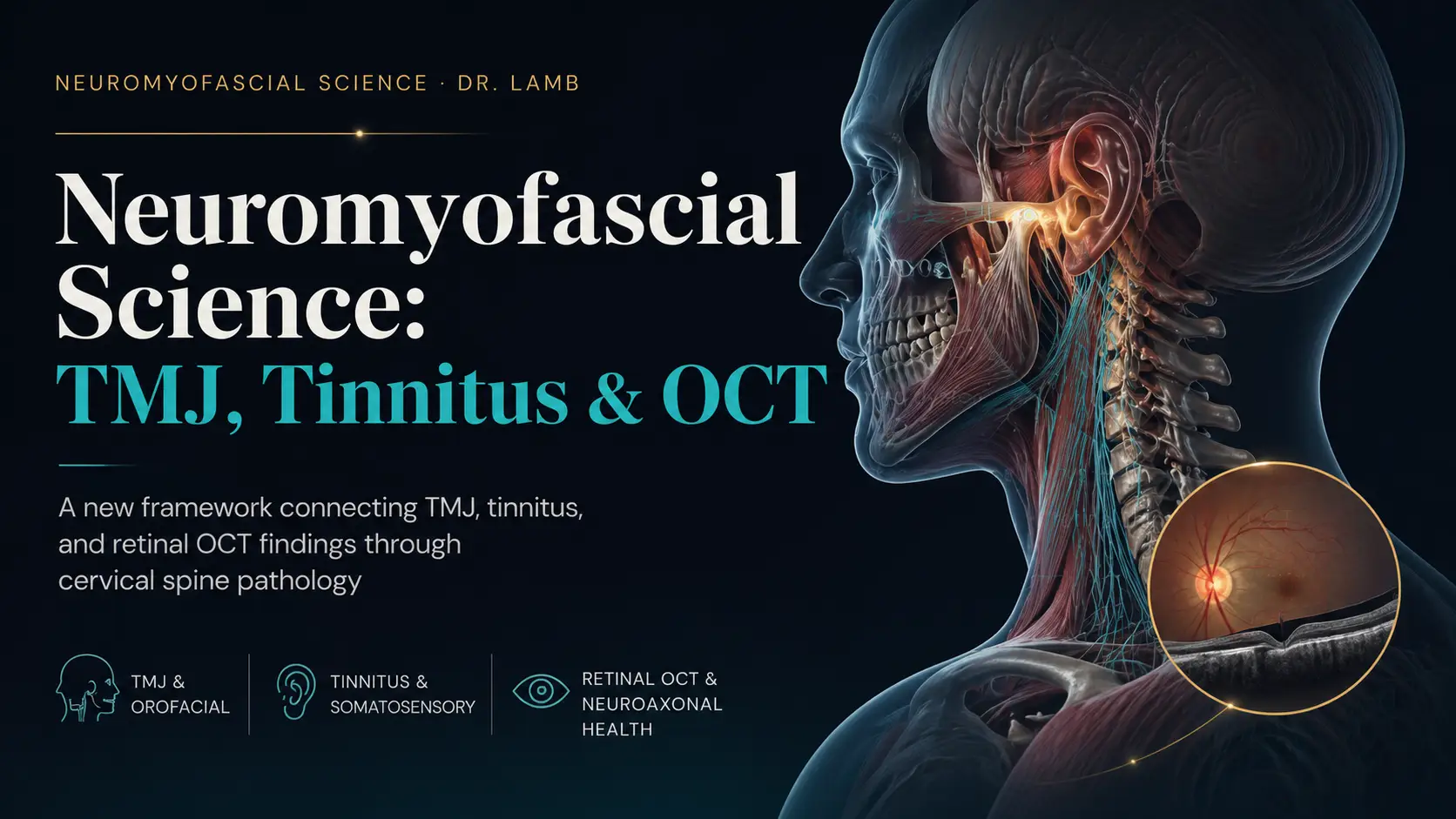
Tinnitus and temporomandibular joint dysfunction are usually treated as separate conditions, one sent to an audiologist, the other to a dentist. NMF Science investigates whether both may be downstream symptoms of a single underlying injury pattern originating in the cervical and upper thoracic spine. When the spine is examined as a possible source rather than the ear or the jaw alone, the clinical picture can look different, and so can the path toward relief.
Current Medical Understanding
Tinnitus is typically understood as a hearing problem originating in the inner ear. The persistent ringing, humming, or hissing that characterizes tinnitus is most often attributed to damage of the delicate hair cells inside the cochlea, or to dysfunction of the auditory nerve. Treatment focuses on managing the sound perception through hearing aids, sound therapy, and in some cases medication. There is no widely accepted cure.
Temporomandibular joint disorder, or TMJ dysfunction, is understood as a problem with the jaw joint itself. The clicking, locking, and pain associated with TMJ are attributed to joint misalignment, stress-related clenching, or dental occlusion problems. Treatment focuses on the joint and surrounding muscles through bite guards, dental work, physical therapy, and occasionally surgical intervention on the joint.
The clinical challenge is that these two conditions rarely appear in isolation. People with tinnitus frequently also report neck pain, headaches, and jaw discomfort. People with TMJ dysfunction show similar symptom clustering. Systematic reviews and meta-analyses consistently report a significant association between the two, with reported odds ratios varying widely across studies, and tinnitus is also commonly reported following concussion. Yet the standard medical approach continues to route patients to separate specialists who treat each symptom as an isolated local problem. The connection between them often remains unaddressed.
NMF Science Perspective
NMF Science does not replace audiological or dental care for tinnitus and TMJ dysfunction. What it does is investigate whether both conditions may share a common structural origin in the cervical and upper thoracic spine, and whether mapping that origin produces a more complete picture of what is contributing to the symptoms.
The proposed mechanism begins with trauma. Acceleration-deceleration events such as whiplash from a motor vehicle collision, or years of cumulative biomechanical strain, may cause microscopic tearing across the cervical and thoracic vertebrae. The body responds by forming dense neuromyofascial scar tissue around the injured area. The NMF Science hypothesis is that over time this tissue can become pathological, restricting normal spinal movement and initiating effects that reach into the jaw and inner ear through two neurological pathways.
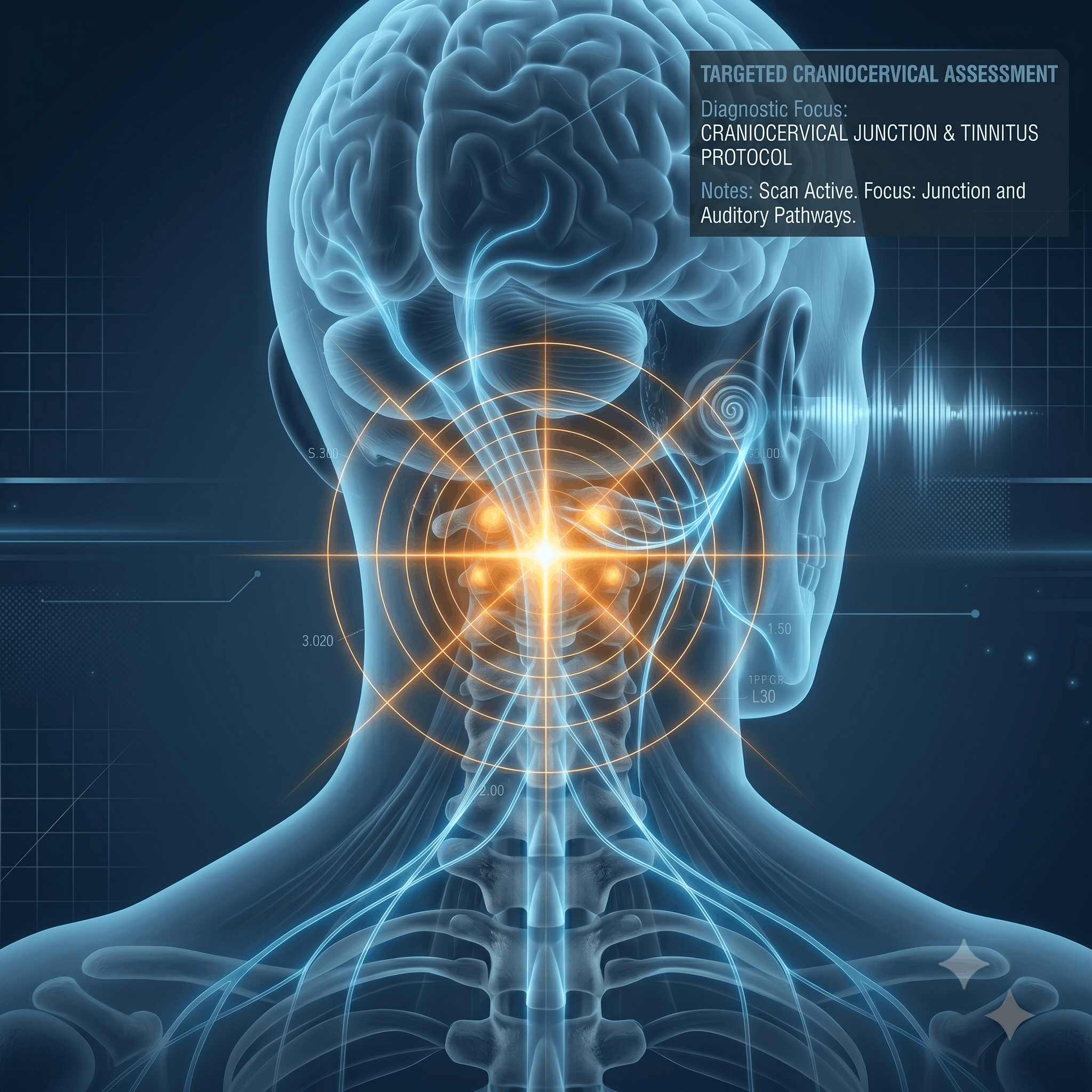
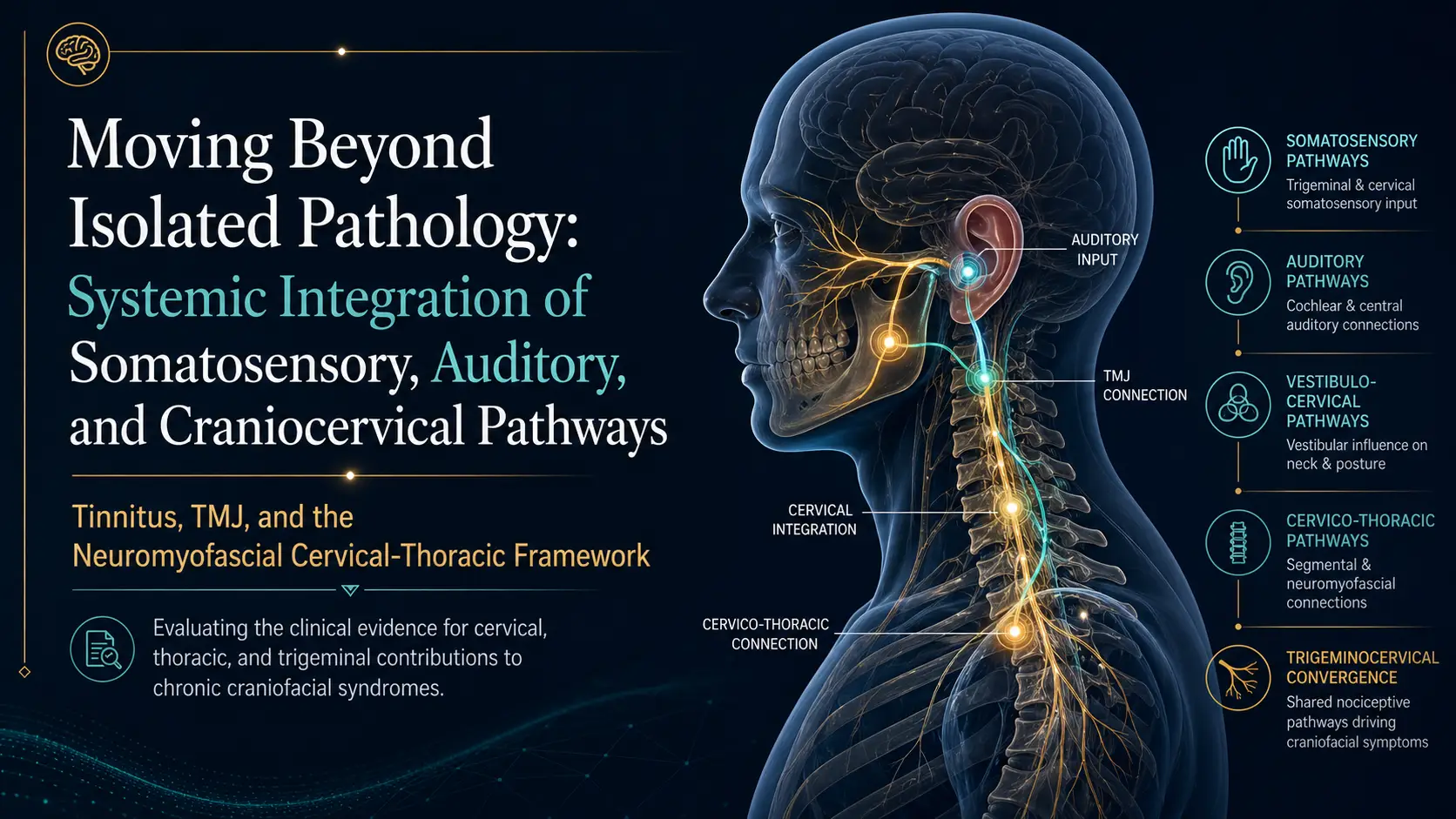
The first pathway runs through the trigeminal cervical complex, or TCC. This is the brainstem junction where signals from the trigeminal nerve, which serves the face, jaw, and chewing muscles, converge with signals from the cervical nerves serving the neck. This convergence is well established in the pain literature and helps explain why cervical problems can refer pain into the face and head. The NMF Science proposal is that chronic cervical spine strain contributes to sensitization at this junction, lowering the pain threshold across the craniofacial network, so that a flare-up of cervical tension may produce pain behind the eyes, jaw locking, or severe headache with the jaw as the endpoint rather than the source.
The second pathway runs through the dorsal cochlear nucleus, or DCN. Adjacent to the TCC, the DCN is an auditory relay station where sound signals from the ear meet sensory signals from the neck and jaw. Somatosensory tinnitus, in which the perceived sound changes with jaw clenching, head rotation, or pressure on specific neck muscles, is a recognized clinical phenomenon and can be observed directly during examination. The NMF Science proposal is that in some patients this reflects cervical injury signals influencing auditory processing, rather than damage originating in the ear.
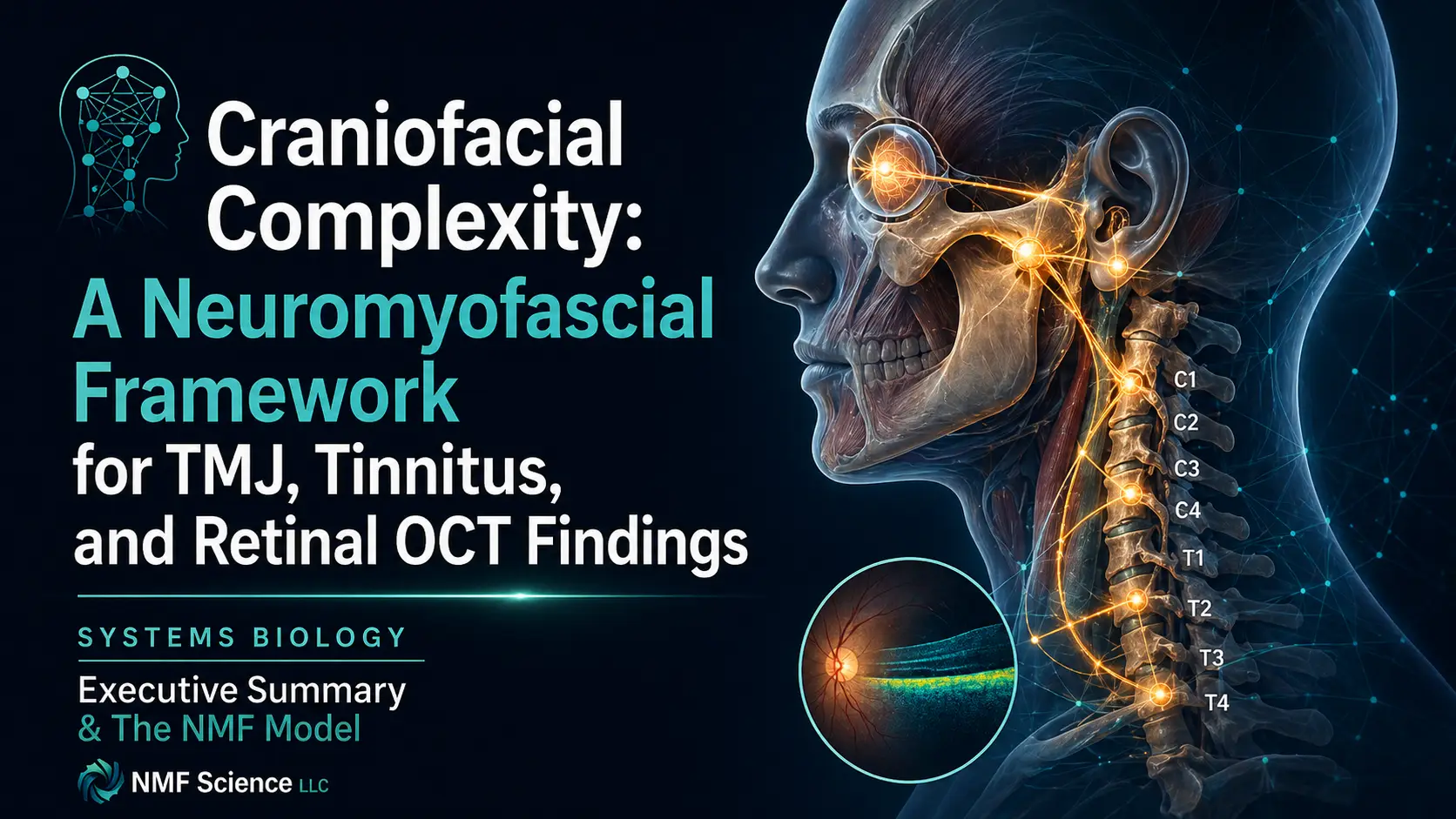
Both conditions may also connect through OCT findings. Optical coherence tomography measures the microscopic thickness of the retinal nerve fiber layer, which is an extension of the central nervous system. Research documents retinal thinning in patients with chronic migraines, traumatic brain injury, and MS. Emerging evidence suggests similar thinning in patients with chronic tinnitus and TMJ dysfunction. The proposed mechanism is that persistent spinal cord tethering creates indirect mechanical stress along the neurological chain from the spine through the brainstem and into the optic nerve and retina. This is presented as a hypothesis and an active area of research, not settled clinical fact.
This does not mean tinnitus originates in the spine in every patient, nor that all TMJ dysfunction is related to cervical pathology. It means that in a subset of patients, a treatable spinal injury pattern may be contributing to or amplifying both conditions. Mapping that pattern is a starting point for understanding the full picture.
When the Ear and Jaw Are Blamed for a Spinal Problem
One pattern observed in patients presenting with both tinnitus and TMJ dysfunction is a history of cervical spine trauma, often from an event that occurred years before the ear and jaw symptoms became chronic. A rear-end collision, a sports impact, or prolonged postural strain may gradually build a neuromyofascial injury pattern. By the time the tinnitus and jaw pain become severe enough to prompt specialist care, the earlier cervical injury has often been forgotten or was never connected to the symptoms at all.
The jaw dysfunction component follows a pattern worth understanding. The NMF Science proposal is that cervical spine injury can contribute to dystonia in the mastication muscles, including the temporalis, masseter, and pterygoid muscles. Dystonia here means a state of chronic involuntary spasm. Chewing muscles held in constant low-grade spasm may pull the jaw off its natural hinge, producing clicking, locking, and pain as a secondary mechanical consequence of muscles compensating for structural damage deeper in the cervical spine. In these cases, the framework proposes that the joint is the endpoint rather than the origin.
A further observation is that tinnitus and TMJ dysfunction may be early indicators of a wider neuromyofascial injury pattern. Clinical observations suggest that patients presenting with both conditions often also carry overlapping diagnoses of post-concussion syndrome, migraine, fibromyalgia, and in some cases MS-spectrum presentations. NMF Science proposes that rather than representing five separate conditions, these may in some patients represent different expressions of one underlying spinal injury pattern. This is a hypothesis that would require formal study to test. The neuromyofascial map is the tool used to investigate those connections.
What We Investigate
→ History of acceleration-deceleration trauma, concussive events, sports impacts, or cumulative postural strain that may have initiated a cervical injury pattern contributing to craniofacial and auditory symptoms.
→ Craniocervical junction integrity at C0-C1 and C1-C2 as a potential structural contributor to trigeminal nerve irritation, jaw muscle dystonia, and auditory pathway disruption.
→ Somatosensory tinnitus assessment: whether jaw clenching, head rotation, or cervical muscle pressure changes the pitch or volume of tinnitus, which may indicate somatic involvement rather than isolated cochlear damage.
→ Trigeminal cervical complex involvement: whether craniofacial pain, jaw locking, eye pain, or headache distribution maps to referral patterns consistent with cervical nerve irritation.
→ Dystonia in the mastication muscles including the temporalis, masseter, and pterygoid, and whether this represents primary TMJ pathology or secondary spasm related to cervical spine injury.
→ Cervical and upper thoracic range of motion, segmental restriction, vertebral alignment, and fibrosis patterns at key injury sites that may not be visible on standard MRI.
→ Hypermobility as a diagnostic blind spot: whether normal or excessive cervical range of motion is masking deeper structural injury and neuromyofascial scarring at the craniocervical junction.
→ OCT findings: whether retinal nerve fiber layer thinning is present, and whether this correlates with a broader cervical and craniofacial injury pattern.
→ Overlapping condition pattern: whether the patient also carries diagnoses of post-concussion syndrome, migraine, fibromyalgia, or other conditions that may suggest a shared neuromyofascial spectrum.
→ Treatment response as a mapping tool: whether targeted neuromyofascial intervention at cervical injury sites produces measurable change in tinnitus pitch or volume, jaw mobility, or craniofacial pain, and what that response suggests about the origin of the symptom pattern.
Learn More About TMJ and Tinnitus
Below you will find our most comprehensive educational resources on TMJ dysfunction and tinnitus from the NMF Science perspective. Explore detailed video explanations, clinical slideshows, and in-depth articles examining the cervical and neuromyofascial contribution to these two frequently misconnected conditions.
Videos
Slideshows
Social Media Videos