CONDITIONS
Sciatica and Lower Limb Radiculopathy
Sciatica is typically explained as a single herniated disc compressing a nerve root at the lower lumbar spine. Yet patients with similar MRI findings can experience very different levels of pain and disability. Some have mild intermittent discomfort. Others develop severe leg weakness, sudden instability, or pain radiating in patterns that do not match the expected nerve distribution at all. NMF Science investigates why that variability exists and what a neuromyofascial map may reveal about the broader mechanical picture that disc-focused care is not designed to address.
Current Medical Understanding
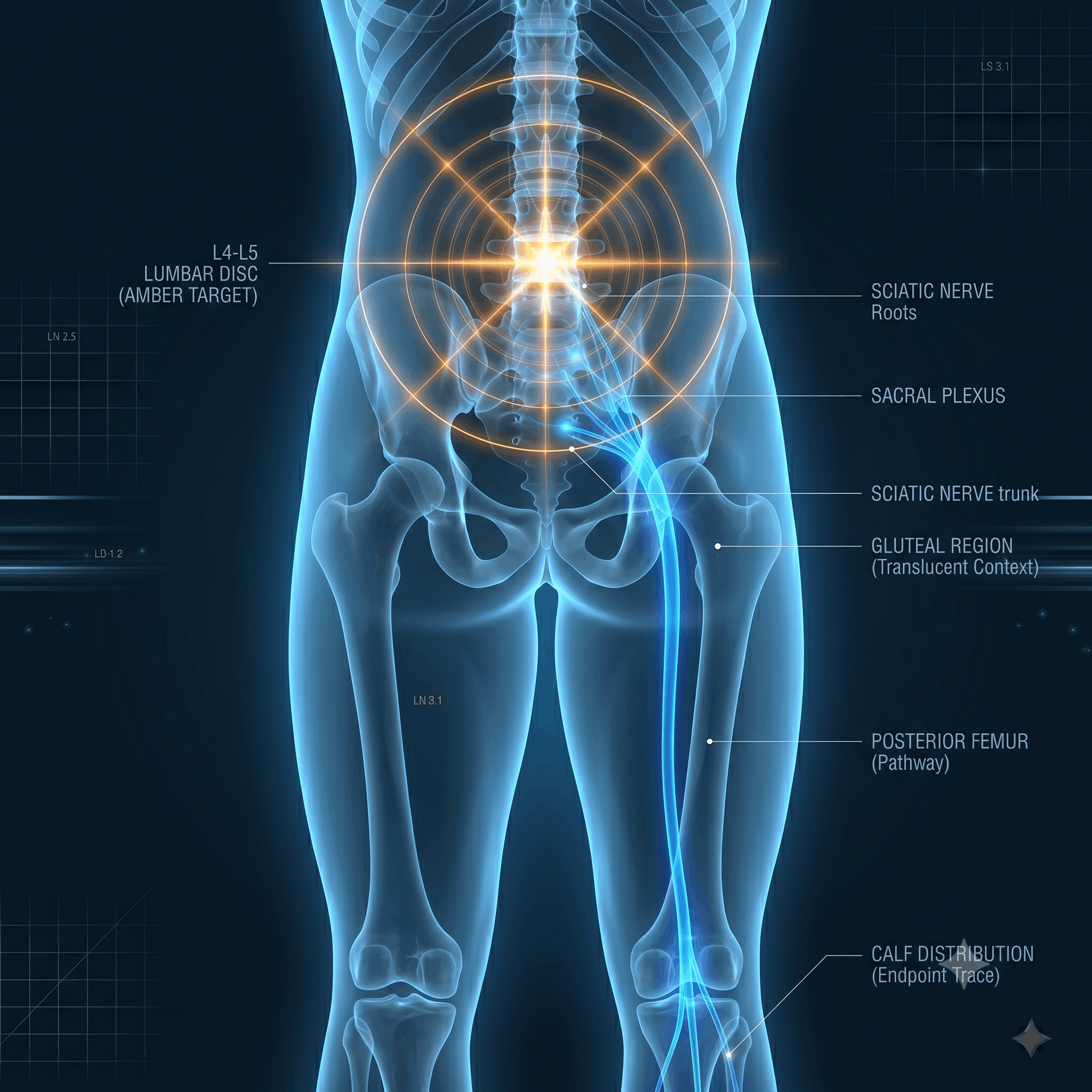
Sciatica is traditionally described as pain caused by compression of the sciatic nerve or its roots at the lower lumbar spine, most commonly at the L4-L5 or L5-S1 level. A herniated or bulging disc is the most frequently cited cause. Diagnosis relies on symptom patterns and imaging through MRI or CT scans. Conventional treatment targets the compression directly through rest, anti-inflammatory medications, physical therapy, epidural steroid injections, and in some cases surgical decompression.
Many patients improve with this approach, particularly in acute presentations where the disc herniation is the primary driver. The clinical challenge arises in chronic and recurrent cases, where patients improve only partially or find that symptoms return after a period of relief. Research supports caution in attributing symptoms to imaging findings alone. A systematic review of imaging in 3,110 people without symptoms found disc degeneration in 37 percent of 20-year-olds, rising to 96 percent of 80-year-olds, and disc bulges in 30 percent rising to 84 percent. The authors concluded that many degenerative imaging features are likely part of normal aging, are not necessarily associated with pain, and must be interpreted in the context of the patient's clinical condition (Brinjikji et al., 2015).
Spinal stenosis, a narrowing of the spinal canal, is also commonly identified as a driver of sciatic-type symptoms. Standard medicine typically treats it as a structural narrowing at one or two spinal levels. What is less often considered is whether the stenosis may represent the endpoint of a broader mechanical breakdown rather than a single anatomical problem requiring a single anatomical solution.
References
Brinjikji W, Luetmer PH, Comstock B, et al. Systematic literature review of imaging features of spinal degeneration in asymptomatic populations. AJNR Am J Neuroradiol. 2015;36(4):811-816. https://pubmed.ncbi.nlm.nih.gov/25430861/
NMF Science Perspective
NMF Science does not dismiss the role of disc herniation or spinal stenosis in sciatica. What it investigates is the broader mechanical picture that may create and sustain nerve root irritation, and why standard treatment sometimes produces incomplete or temporary relief when that broader picture remains unaddressed.
The NMF Science framework proposes that chronic sciatica often stems from accumulated injuries that have created neuromyofascial pathology around the paraspinal muscles of the lumbar spine. The hypothesis is that scar tissue and fibrosis in these muscles alter the normal mechanics of the lower back, with the most significant consequence being a loss of normal lumbar lordosis, the natural inward curve of the lower spine. Where that curve straightens, the proposal is that vertebrae no longer articulate smoothly, internal disc pressures shift, and nerve roots exiting the spine experience persistent mechanical tension rather than simple point compression.
In this model, mechanical tension acts as a tethering force. Rather than a single pinch point, the nerve root would be subject to sustained pulling as it exits the spine and travels down the leg. Whether nerve tethering of this kind is a significant driver in chronic sciatica, and whether addressing it changes outcomes, is a question that warrants formal study.
The framework further proposes that motor involvement from chronic nerve root irritation drives additional downstream consequences. Muscle dystonia, spasticity, and trigger point formation may develop in the pelvis, hip, thigh, calf, and foot as secondary responses to compromised nerve supply. NMF Science proposes that these downstream changes can amplify pain and disability beyond what spinal compression alone would produce, and that the combination of tethering above and motor involvement below may account for the full spectrum of sciatic disability in some patients.
Spinal stenosis in this framework may not always be a single-level narrowing. Clinical observations suggest that severe stenosis can involve multiple areas of vertebral misalignment, creating an irregular pathway through the spinal canal where smooth nerve gliding is replaced by multipoint tethering. If that is correct, distributed mechanical dysfunction of this kind would not be fully resolved by addressing a single disc level, and would call for evaluating the lumbar spine, lower thoracic spine, pelvis, hips, and lower limbs as one connected system.
This does not mean that surgical decompression is never appropriate or that imaging findings are irrelevant. It means that in cases of chronic, complex, or treatment-resistant sciatica, the neuromyofascial map of the full lower limb system deserves investigation alongside the structural findings that standard imaging captures.
When Sciatica Does Not Follow the Expected Pattern
One diagnostically important pattern in complex sciatica is the atypical presentation. Classic sciatica follows a predictable nerve root distribution. L4 tends to produce lateral thigh and shin pain. L5 tends to produce outer calf and top-of-foot symptoms. S1 tends to produce posterior calf and heel symptoms. When a patient's pain does not follow these distributions, or when multiple distributions are involved simultaneously, standard care can struggle to find a satisfying explanation.
NMF Science treats these atypical presentations as useful diagnostic clues. Pain along the outer thigh and calf without foot numbness, an externally rotated gait pattern, sudden leg heaviness or legs that give way on stairs, or pain concentrated in the hip and upper lower back rather than the classic sciatica distribution may all point toward concurrent involvement of both the thoracic and lumbar spine rather than a single disc level. Clinical literature describes a related concept as hip-spine syndrome, where overlapping pathologies from adjacent regions create a picture that neither hip nor spine investigation alone fully explains.
Coordination loss and clumsiness are also commonly reported in these complex presentations. Chronic nerve root irritation is associated with motor changes in the leg muscles, and where the neurological signals governing precise movement are compromised, the result may be not only pain but altered motor control affecting gait, balance, and the ability to navigate stairs or uneven surfaces safely. Mapping the full neuromyofascial system from the thoracic spine through the pelvis and down to the foot is how the framework investigates which components may be contributing to each specific symptom.
What We Investigate
→ Severity and location of nerve root compression at L4-L5 and L5-S1 and whether the structural cause is disc herniation, fibrosis, loss of lordosis, or a combination of factors at multiple levels.
→ Loss of normal lumbar lordosis and whether straightening of the lumbar curve may be creating mechanical tethering of the nerve root beyond the local compression that imaging identifies.
→ Paraspinal fibrosis patterns around the lumbar segments and whether scar tissue from previous injuries may be affecting spinal mechanics and contributing to ongoing nerve root irritation.
→ Motor involvement in the leg: whether calf muscles, hip stabilizers, gluteal muscles, or foot intrinsic muscles show signs of dystonia, weakness, spasticity, or trigger point formation consistent with chronic nerve root involvement.
→ Sensory patterns: whether pain, numbness, tingling, or coordination loss follows specific nerve root distributions or spans multiple distributions suggesting multi-level involvement.
→ Atypical presentations including outer thigh pain without foot symptoms, externally rotated gait, leg heaviness, sudden give-way episodes, or hip-dominant pain that may suggest hip-spine syndrome rather than single-level disc compression.
→ Lower thoracic spine involvement and whether concurrent thoracic injury may be contributing to the lower limb picture in ways that lumbar-only assessment would miss.
→ Dynamic mechanical factors that static MRI may not capture, including movement-dependent narrowing, load-bearing effects on the spinal canal, and postural changes not visible in a resting scan position.
→ Trigger point formation in pelvic, gluteal, hamstring, calf, and foot muscles and whether these may be amplifying radicular pain beyond the level of spinal compression alone.
→ Treatment response patterns: whether neural mobilization, lumbar neuromyofascial intervention, or pelvic and hip rehabilitation produce measurable improvement in leg symptoms, and what that response suggests about the mechanical contribution to the overall symptom map.
Learn More About Sciatica
Below you will find our most comprehensive educational resources on sciatica and lower limb radiculopathy from the NMF Science perspective. Explore detailed video explanations, clinical slideshows, and in-depth articles examining the full mechanical picture behind sciatic nerve pain, the hip-spine syndrome concept, and what neuromyofascial mapping adds to our understanding of why some sciatica presentations resist standard treatment.
Videos
Slideshows