Sleep disruption is one of the most commonly reported but least investigated consequences of whiplash injury. Patients describe difficulty falling asleep, frequent nighttime waking, unrefreshing sleep, and persistent daytime fatigue that does not resolve as their other whiplash symptoms improve. In many cases these symptoms are attributed to pain-related sleep disruption or to anxiety following the accident. The research suggests the picture may be more complicated than that.
The possible connection between cervical spinal injury and sleep-disordered breathing is an area that deserves more attention than it currently receives in standard post-whiplash care.
What the Research Shows
Guilleminault and colleagues (2000) systematically evaluated 184 patients reporting daytime sleepiness after head or neck trauma, using polysomnography, multiple sleep latency testing, actigraphy, and detailed assessment of function before the injury. Their finding in the whiplash subgroup is notable: sleep-disordered breathing was a common finding, and it was the only finding in whiplash patients with daytime sleepiness. Their assessment of pre-trauma behaviour supported the conclusion that the onset of symptomatic sleep-disordered breathing was associated with the trauma itself.
That is a meaningful result. It suggests that in at least some whiplash patients, disrupted sleep is not simply pain keeping someone awake. It is a breathing problem during sleep that appears to have begun with the injury.
Pain clearly matters as well. Valenza and colleagues (2012) compared sleep quality in 22 patients with whiplash-associated neck pain, 19 with mechanical neck pain, and 18 healthy controls. Seventy-seven percent of the whiplash group reported poor sleep quality, and the intensity of ongoing pain correlated significantly with sleep quality, sleep efficiency, and overall sleep scores. The authors concluded that addressing the cycle of pain and sleep disturbance should be an integral part of treatment.
More recent work suggests sleep is not only a consequence but a marker of who recovers. Lutke Schipholt and colleagues (2024) followed 50 people from within two weeks of acute neck pain onset out to six months and identified distinct recovery trajectories. Ongoing systemic inflammation, sleep disturbances, and elevated psychological factors including stress, anxiety, and depression symptoms were mainly present in the unfavourable recovery trajectories rather than the favourable ones. Sleep disturbance travelled with poor recovery, alongside inflammation and psychological load rather than instead of them.
Taken together, these studies point toward something worth investigating rather than assuming: sleep problems after neck injury may involve pain, inflammation, psychological factors, and in some patients a physiological breathing component, and the last of those is not typically looked for.
The Oropharyngeal Finding in Elliott’s MRI Research
One line of imaging research is worth examining here, with its limitations stated clearly. The serial MRI program led by James Elliott, whose cervical muscle fat infiltration work has been discussed elsewhere on this site, also measured the oropharynx.
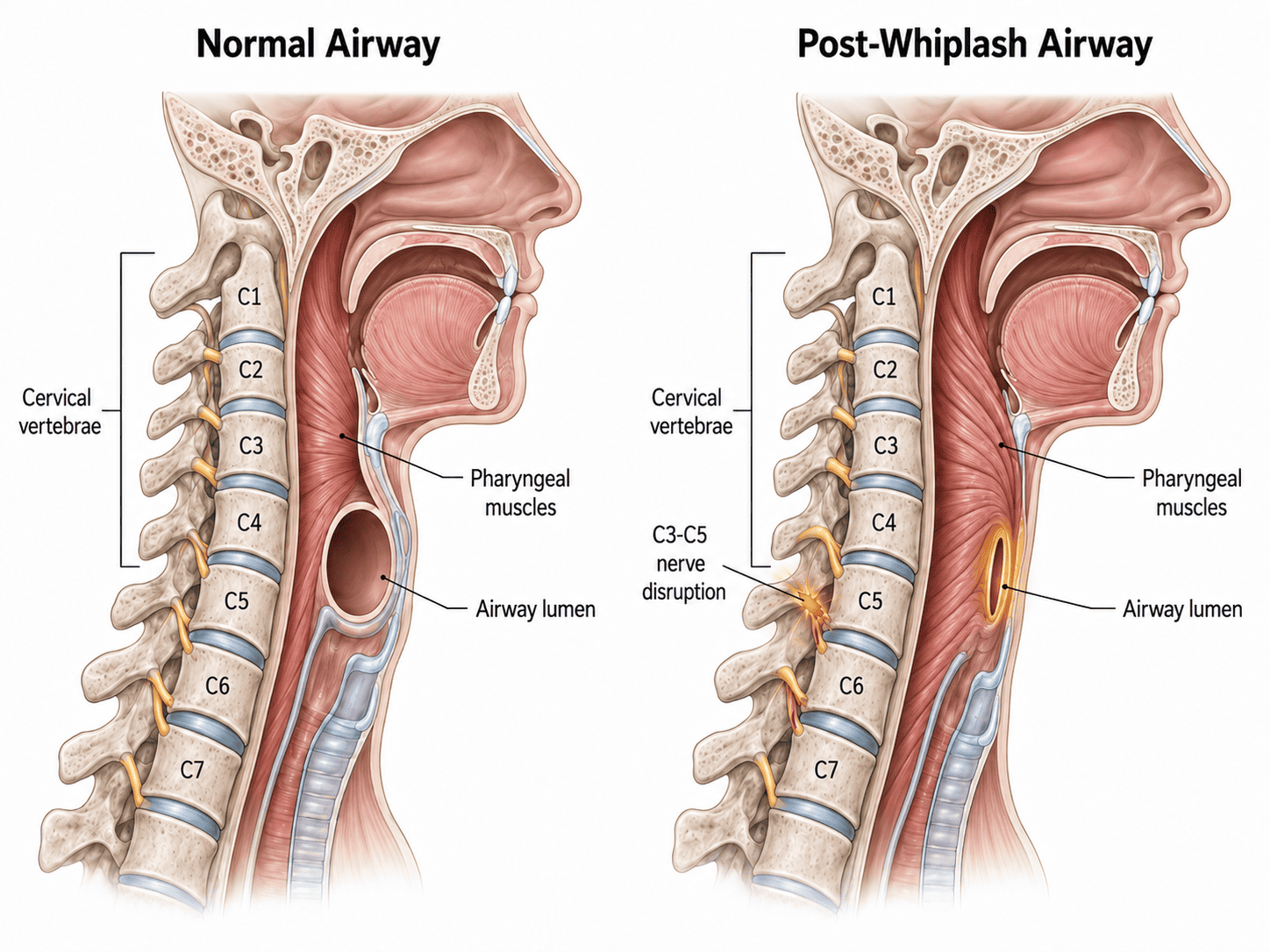
Elliott and colleagues (2008) compared 79 women with chronic whiplash-associated disorder against 34 healthy controls and found significantly smaller oropharyngeal cross-sectional areas and altered shape ratios in the whiplash group. A prospective follow-up (2012) tracked 41 patients from four weeks to six months after acute whiplash injury, measuring how oropharyngeal morphology developed over time in relation to disability.
Three caveats belong alongside those findings. The 2008 study found no association between oropharyngeal size or shape and the patients’ reported pain, disability, or symptom duration. The finding has not consistently replicated: a 2023 shape modelling study found no association between oropharynx shape and whiplash-associated disorder, and separate work measuring oropharyngeal volume did not reproduce the earlier differences. And this research was conducted in the context of swallowing and voice difficulty after whiplash, not sleep-disordered breathing.
What it establishes, then, is narrower than a mechanism: some imaging research has found altered upper airway morphology in whiplash patients, the finding is contested, and it has not been studied in relation to sleep.
A Hypothesis Worth Testing
Putting the Guilleminault sleep finding next to the Elliott airway finding raises an obvious question, which nobody has yet answered: are they connected?
My working hypothesis is that whiplash-related disruption of the motor nerve supply to the upper airway muscles could account for both. The cervical region contributes motor innervation to the musculature of the oropharynx and upper airway. If significant cervical trauma disrupted that supply, affected muscles might lose normal tone regulation as denervated muscle does elsewhere, developing persistent shortening and, over time, structural change. In the airway, that would narrow the passage through which air moves during sleep, producing obstructive sleep apnea arising not from obesity, anatomical variation, or central neurological causes, but from the consequences of cervical injury.
This is a clinical hypothesis. It has not been tested, and the evidence it draws on is partly contested. Testing it would require imaging airway dimensions alongside formal sleep studies in a whiplash cohort, with attention to whether airway changes track with sleep-disordered breathing rather than with swallowing symptoms. That study has not been done. It would be worth doing, and until it is, the connection remains a proposal rather than a finding.
Nighttime Urination as a Clinical Signal
One symptom pattern I have observed in whiplash patients with sleep disruption is frequent nighttime urination, specifically the sensation of needing to urinate that wakes a patient repeatedly through the night, often with only small volumes passed.
In conventional medicine, frequent nighttime urination prompts investigation of the bladder, prostate, kidneys, and blood sugar. Those investigations are appropriate and should be pursued first. But nocturia is also a recognized feature of obstructive sleep apnea, and where those standard workups return normal in a patient who developed this pattern after a whiplash event, sleep quality and breathing are reasonable things to examine next.
This does not mean that every whiplash patient with nighttime urination has sleep apnea or an airway problem. It means that when this symptom appears after whiplash alongside fatigue, unrefreshing sleep, and daytime sleepiness, a sleep assessment may be more useful than attributing it to pain or anxiety.
What This Means for Patients
Patients with whiplash who are not sleeping well deserve investigation that considers sleep-disordered breathing as a possibility, not only reassurance that pain is disrupting their rest. The Guilleminault data suggests that in a subgroup of these patients, something measurable is happening during sleep, and that it started with the injury. The recovery trajectory research suggests that sleep disturbance is worth taking seriously as a marker of who may not recover well.
Whether the cervical spine is the mechanism behind any of this is an open question. It is a question worth asking, and worth studying properly.
The information in this article is educational and informational in nature. It is not intended as a substitute for professional medical advice, diagnosis, or treatment. If you are experiencing sleep disturbance or other symptoms following a whiplash injury, consult with a qualified healthcare provider to discuss appropriate assessment and care.