CONDITIONS
Migraines
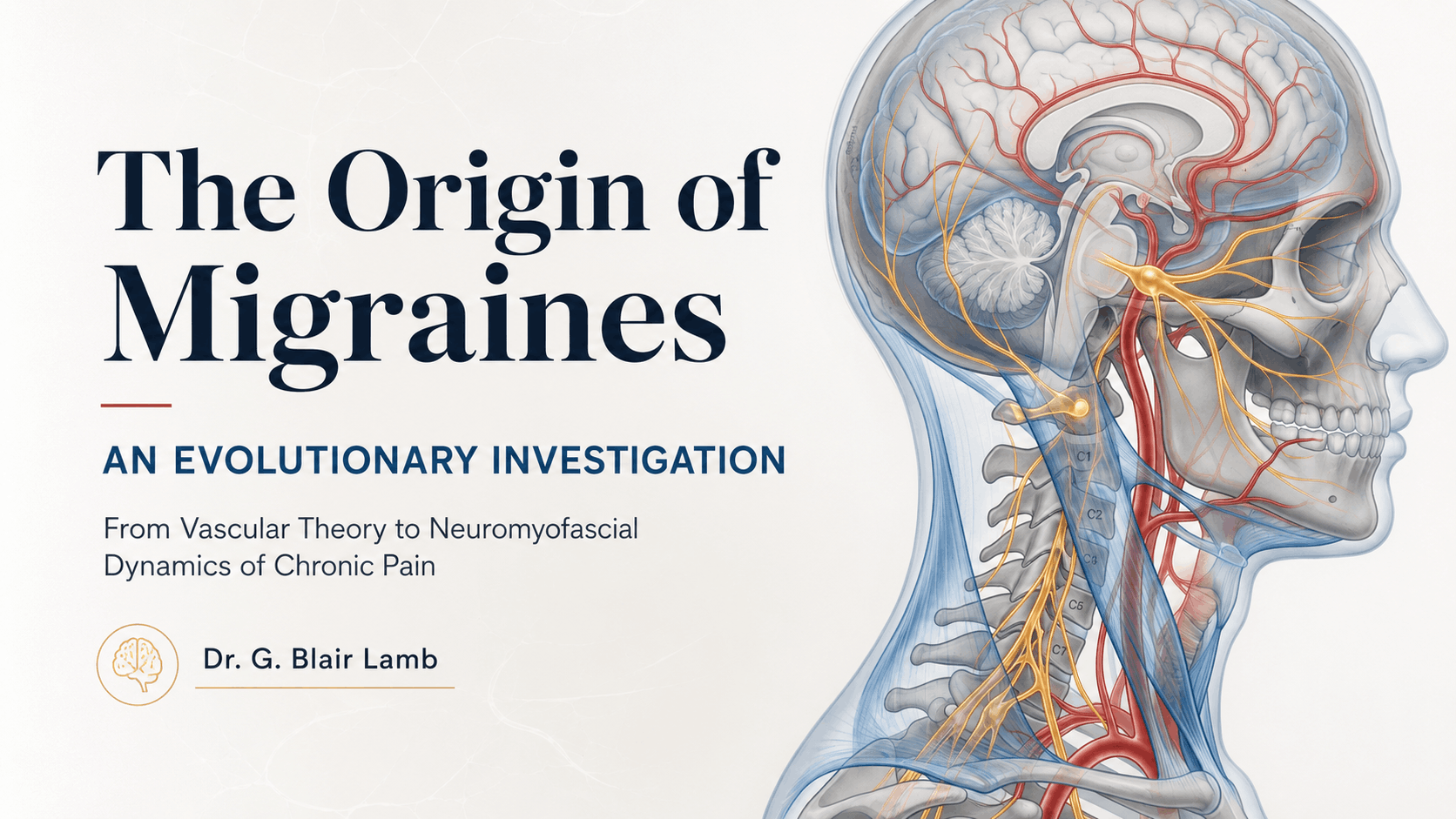
Migraine has challenged humanity for thousands of years, evolving from ancient surgical interventions to modern pharmacology. Yet for many people living with chronic migraine, available treatments offer only partial relief. NMF Science investigates whether, for some patients, migraine is driven not by spontaneous brain dysfunction alone but by a progressive, mappable injury pattern in the cervical spine that activates the trigeminal system and contributes to the neurochemical cascade that standard medicine treats at the symptom level. For those patients, that distinction may change the investigational approach.
Current Medical Understanding
Modern medicine understands migraine as a neurological condition involving the trigeminal system, neurogenic inflammation, and a neuropeptide called calcitonin gene-related peptide, or CGRP. The trigeminal system activates, CGRP is released in the meninges, and pain results. The classic presentation involves four phases: premonitory symptoms, visual aura, throbbing one-sided head pain, and postdrome fatigue. Diagnosis relies on symptom patterns and timing. Treatment focuses on blocking CGRP production or activity through triptans, CGRP inhibitors, and preventive medications.
This framework has helped many patients manage migraine attacks. However it generally treats trigeminal activation as spontaneous or triggered by environmental factors, with the brain's pain-processing systems as the primary target of care. For a subset of patients, this approach produces only partial improvement. Migraines return, worsen over time, or evolve into more complex presentations that spread to the jaw, face, teeth, ears, or arms in ways that do not fit the classical migraine picture.
The medical approach to these complex presentations typically involves adjusting medications, referring to additional specialists, or investigating for other conditions. What is less often explored is whether the physical structures of the cervical spine may be an upstream contributor to trigeminal activation in some patients.
NMF Science Perspective
NMF Science does not dismiss the neuroscience of CGRP or the trigeminal system. What it does is ask a question that standard migraine workups are not designed to answer: in a given patient, what may be activating the trigeminal system?
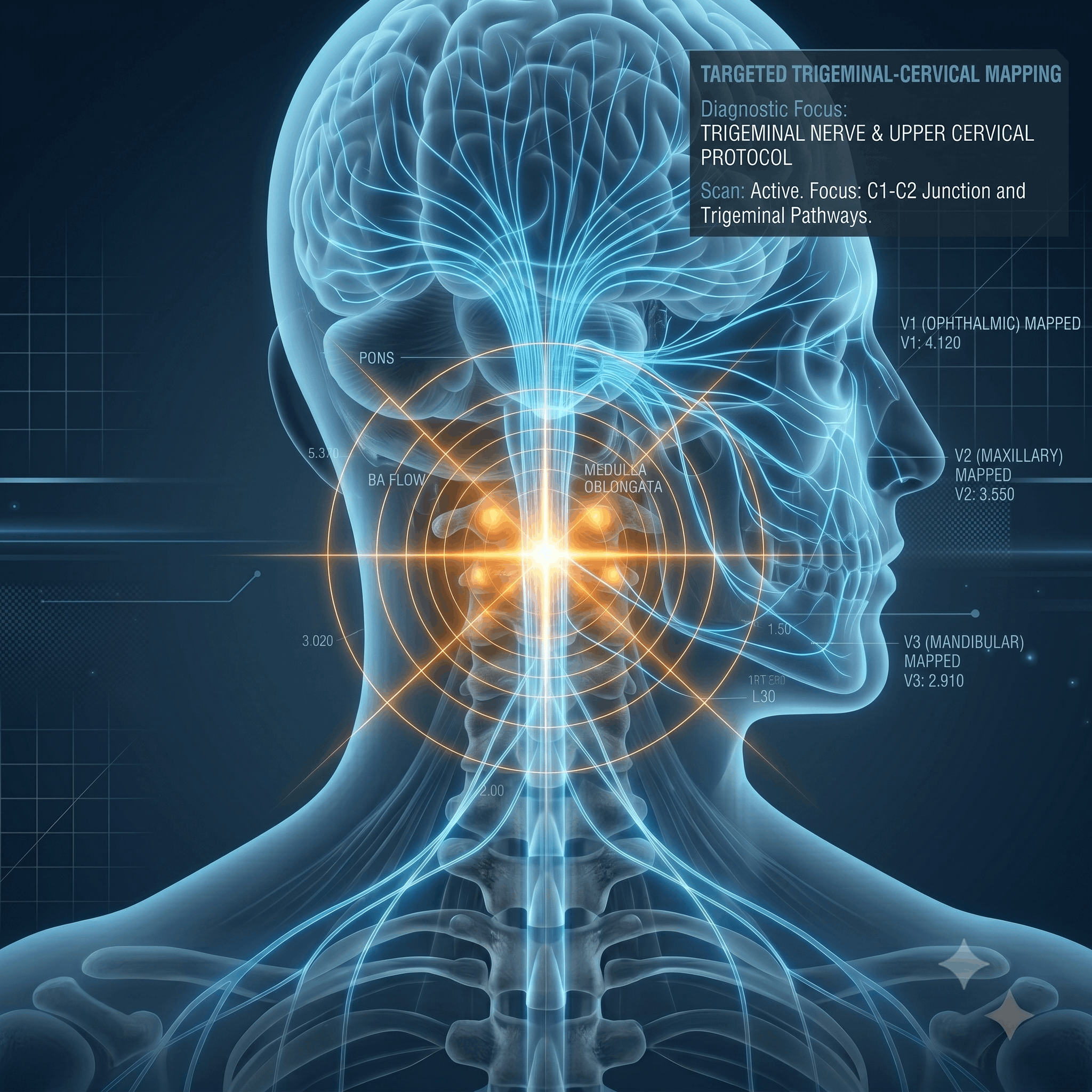
The NMF Science framework proposes a mechanism chain. Physical trauma, including sports injury, whiplash, falls, or accumulated micro-trauma, may create high-density fibrosis around the C1-C2 vertebrae at the top of the cervical spine. The hypothesis is that this scar tissue, which is not typically visible on standard imaging, restricts normal cervical movement and irritates the exiting cervical nerve roots, and that this cervical nerve irritation feeds into and amplifies trigeminal pathways, contributing to the cascade that produces migraine.
A useful way to describe the distinction is the match and the fire. CGRP release and neurogenic inflammation are the fire. The NMF Science proposal is that in some patients, ongoing cervical nerve irritation is the match. Standard migraine treatment addresses the fire effectively and appropriately. NMF Science investigates whether a structural contributor can also be identified and addressed through neuromyofascial mapping, potentially reducing the stimulus that contributes to the cascade.
Where those cervical nerves are irritated, the framework proposes the effects may not stay localized to the head. Cervical nerve irritation is associated with craniofacial referral patterns including jaw tightness and TMJ dysfunction, unexplained dental pain, sinus-like pressure, tinnitus, and vertigo. In the NMF Science framework these may be downstream expressions of the same cervical injury pattern, each representing a different nerve distribution affected by the same structural factor, rather than separate unrelated conditions.
The framework further proposes that as fibrosis spreads over time from the upper cervical spine into the thoracic spine and brachial plexus, the symptom picture may expand. Carpal tunnel-like symptoms, ulnar neuritis, shoulder dysfunction, and arm weakness sometimes appear in patients living with complex migraine for years. NMF Science proposes these may represent anatomical spread of the same neuromyofascial injury pattern rather than unrelated developments.
At its most advanced stage, this presentation can resemble post-concussion syndrome or prompt investigation for demyelinating disease. The appropriate neurological workups remain essential. NMF Science proposes that advanced neuromyofascial injury may create a clinical picture that overlaps with serious neurological conditions, and that mapping the spinal injury pattern is a useful additional investigational step for patients who reach this stage.
Migraine may be the symptom we see. Neuromyofascial injury may be one of the contributing factors behind it in some patients.
What the Research Shows About the Cervical Subgroup
The idea that a cervical injury pattern contributes to migraine in some patients is not unique to NMF Science, and recent research has begun to define who those patients might be.
A research group at the University of Queensland assessed 124 people with migraine using a detailed physical examination of cervical musculoskeletal function, then used cluster analysis to group them by their findings. Two distinct clusters emerged. Roughly one third of participants showed a pattern of cervical dysfunction comparable to people with neck disorders, while the remainder had cervical function similar to healthy controls. Their conclusion was that neck pain occurring with migraine does not by itself indicate cervical dysfunction, and that skilled physical assessment is required to identify the patients who actually have it (Liang et al., Headache, 2021).
The same group has since argued that treating everyone with migraine and neck pain as a single population may explain why cervical interventions have produced limited results in trials, and that identifying subgroups and matching the approach to the mechanism is a more promising direction (Liang et al., Musculoskeletal Science and Practice, 2023).
This research matters for two reasons. It supports the existence of a genuine cervical subgroup within the migraine population, and it establishes that finding that subgroup depends on detailed physical examination rather than symptom reporting alone. That is the same investigational logic behind neuromyofascial mapping.
It also sets an honest limit. Most participants in that study did not show cervical dysfunction, and the NMF Science framework does not propose that cervical injury explains migraine generally. The proposal is narrower: that within the migraine population there is a subgroup whose symptoms have a structural contribution that standard workups are not designed to find, and that identifying those patients is worth doing carefully.
References
Liang Z, Thomas L, Jull G, Minto J, Zareie H, Treleaven J. Neck pain associated with migraine does not necessarily reflect cervical musculoskeletal dysfunction. Headache. 2021;61(6):882-894. https://pubmed.ncbi.nlm.nih.gov/34214181/
Liang Z, Thomas L, Jull G, Treleaven J. Subgrouping individuals with migraine associated neck pain for targeted management. Musculoskelet Sci Pract. 2023;66:102801. https://pubmed.ncbi.nlm.nih.gov/37331924/
Liang Z, Thomas L, Jull G, Treleaven J. Cervical musculoskeletal impairments in migraine. Arch Physiother. 2021;11(1):27. https://pubmed.ncbi.nlm.nih.gov/34876218/
What We Investigate
→ Timeline of migraine onset and any preceding physical trauma including sports injuries, motor vehicle collisions, falls, or repetitive strain that may have initiated a cervical injury pattern.
→ Atlas-axis region integrity at C1-C2 as a potential structural contributor to trigeminal activation and migraine generation on the affected side.
→ Fibrosis around the upper cervical vertebrae and ligaments that may not be visible on standard imaging, and whether findings correlate with the distribution and laterality of migraine symptoms.
→ Migraine staging within the proposed NMF Science spectrum model: whether the presentation maps to Stage 1 (localized and intermittent), Stage 2 (more frequent with craniofacial symptoms), Stage 3 (chronic daily with upper limb involvement), or Stage 4 (multi-region symptoms with significant disability). This staging is a proposed clinical model, not an established classification system.
→ Craniofacial referral patterns including jaw tightness, TMJ dysfunction, dental pain, sinus pressure, tinnitus, and vertigo, and whether these may be downstream indicators of cervical nerve root irritation rather than isolated local conditions.
→ Upper limb involvement including carpal tunnel symptoms, ulnar neuritis, shoulder dysfunction, or arm weakness that may suggest spread of fibrosis into the thoracic spine and brachial plexus.
→ Mechanical triggers: whether specific neck movements, sustained postures, or positional changes consistently precede or intensify migraine attacks, which may suggest a structural contribution alongside neurochemical mechanisms.
→ Whether migraine escalated following specific injury events such as whiplash, concussion, or repeated impacts.
→ Diagnostic overlap: whether the presentation has prompted investigation for post-concussion syndrome, MS, or other neurological conditions, and whether the neuromyofascial map offers an additional structural explanation for overlapping symptoms.
→ Treatment response patterns: whether cervical-focused interventions produce measurable reduction in migraine frequency or severity, and what that response suggests about the structural contribution to the overall symptom map.
Learn More About Migraines
Below you will find our most comprehensive educational resources on migraines and the NMF Science investigational perspective. Explore detailed video explanations, clinical slideshows, and in-depth articles examining the cervical and neuromyofascial contribution to migraine, the proposed four-stage spectrum model, and what the neuromyofascial mapping process adds to our understanding of one of the most common and complex pain conditions in the world.
Videos
Slideshows