CONDITIONS
Elbow Pain
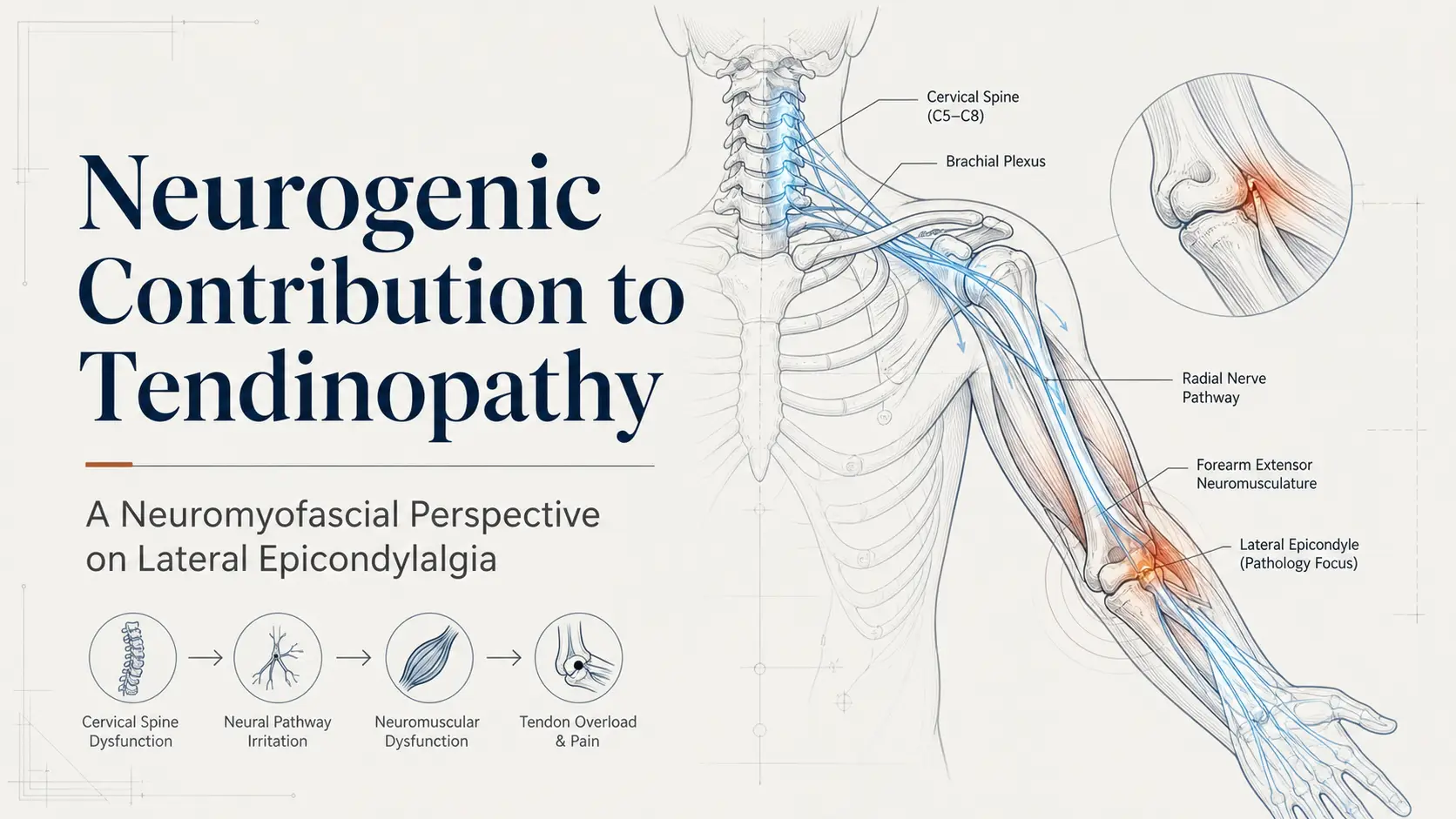
Elbow pain labeled as tennis elbow or lateral epicondylalgia is one of the most commonly treated yet persistently misunderstood musculoskeletal conditions. Standard care focuses on the tendon as the source of the problem. NMF Science investigates whether the cervical and upper thoracic spine may be an upstream contributor in some cases, producing altered motor activity that loads the tendon from above. Where a spinal contribution is identified and addressed, it may help explain why local-only treatment sometimes falls short.
Current Medical Understanding
Tennis elbow, more accurately described as lateral epicondylalgia, is characterized by pain over the lateral epicondyle of the humerus and tenderness at the origin of the wrist extensor tendons. The extensor carpi radialis brevis is the most commonly involved structure. Symptoms include pain with gripping or resisted wrist extension, perceived tightness, and forearm weakness. Repetitive strain and overuse are the most commonly cited causes.
Standard treatment focuses on the local area. Rest, anti-inflammatory medications, corticosteroid injections, forearm strengthening exercises, physiotherapy, platelet-rich plasma injections, and in some cases surgical release of the tendon are the primary options. Each of these approaches treats the tendon as the origin of the problem.
The clinical challenge is that chronic lateral epicondylalgia can persist for months or years despite these interventions. Systematic reviews of treatment outcomes show variable and often modest benefit, particularly in long-term follow-up. Many patients improve partially but see symptoms return. That pattern raises a question worth investigating: in cases that do not follow expected healing timelines, is there an upstream contributor that local treatment is not reaching?
NMF Science Perspective
NMF Science does not dismiss the local tendon pathology in lateral epicondylalgia. What it investigates is whether motor neuropathy originating in the cervical and upper thoracic spine may be an upstream contributor creating persistent muscle dysfunction that loads the tendon from above.
The proposed mechanism chain is specific. The hypothesis is that injury or dysfunction in the cervical spine and cervicothoracic junction produces paraspinal myofibrosis, that this myofibrosis alters motor nerve signaling along the radial nerve distribution serving the forearm extensor muscles, and that the result is persistent low-grade dystonia in subsets of the forearm extensor muscle fibers. Those fibers would maintain sustained hypertonicity, generating continuous abnormal traction at the common extensor tendon origin on the lateral epicondyle. Over time this proposed traction would increase tensile load, contribute to microtrauma, impair normal tendon remodeling, and promote degenerative tendinopathy rather than the acute inflammation that some standard treatment is designed to address.
This framework approaches lateral epicondylalgia less as a purely local tendon disorder and more as a systems-based neuromuscular condition involving spinal motor control, fascial integrity, and distal biomechanical loading. In this model, the tendon may be the endpoint of a mechanical chain beginning in the spine rather than the origin of the problem.
Clinical observations from Dr. Lamb's practice over approximately 30 years suggest that chronic tennis elbow is frequently associated with neuromyofascial dysfunction at the cervical spine segments, the cervicothoracic junction, and the upper thoracic paraspinal tissues. In more complex presentations including repetitive strain injury and chronic regional pain syndrome, multiple levels of cervical and thoracic neuromyofascial dysfunction are often observed on the affected side.
Published research also supports investigating the cervical spine in this condition. In a randomized crossover trial, a single cervical spine manipulation produced an immediate increase in pressure pain threshold at the elbow and improved pain-free grip strength on the affected side compared with a manual contact control (Fernandez-Carnero et al., 2008). A later trial comparing cervical with thoracic manipulation found cervical produced the greater change in pressure pain threshold (Fernandez-Carnero et al., 2011). Both studies were small, with 10 and 18 participants, and measured immediate effects rather than long-term outcomes. A larger multicenter randomized trial of 143 participants found that adding cervical and extremity manipulation to a multimodal physical therapy program produced significantly greater improvement in pain and disability at three months than physical therapy alone (Dunning et al., 2024).
This does not mean local tendon pathology is not real or that standard treatment is without value. It means that in cases of chronic, treatment-resistant elbow pain, the cervical and upper thoracic spine deserves investigation as a potential contributor to the persistence of symptoms.
When the Elbow Is the Endpoint, Not the Origin
One pattern worth examining in persistent elbow pain is the presence of neck and upper back dysfunction that predates or accompanies the elbow symptoms. Patients often report a history of whiplash, repetitive occupational strain involving the neck and shoulder, or upper limb overuse that follows cervical spine injury. In these cases the elbow pain may have emerged gradually rather than from a direct elbow injury, as altered motor nerve function changed the way forearm muscles loaded the tendon over time.
The upper limb functions as a kinetic chain extending from the cervical spine through the shoulder, arm, forearm, and hand. Dysfunction at any point in the chain can concentrate mechanical stress at a more distal location. The elbow may be particularly vulnerable as a concentration point because it sits at the junction of the radial nerve distribution from above and the mechanical demands of grip and wrist extension from below. The NMF Science proposal is that where cervical nerve supply to the forearm extensors is compromised, the elbow can bear the consequence even though the origin lies higher in the chain.
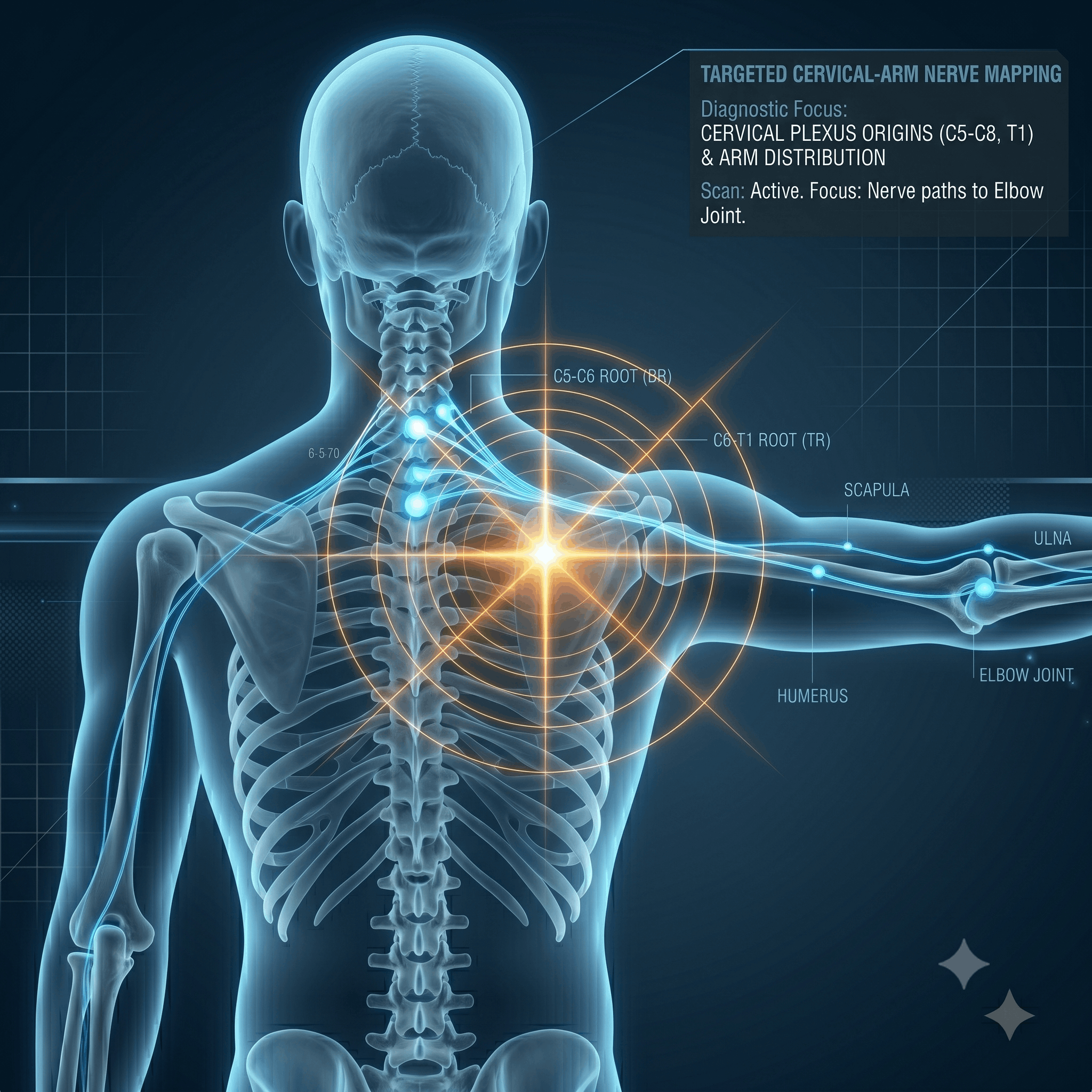
This pattern may also help explain why chronic elbow pain frequently travels with neck stiffness, shoulder tension, forearm tightness, and sometimes wrist or hand symptoms. Rather than separate complaints, the framework proposes these may be different points along the same neuromyofascial chain affected by a shared upstream contributor. Mapping that chain from the cervical spine to the lateral epicondyle is what the neuromyofascial investigational process is designed to do.
What We Investigate
→ Cervical spine and cervicothoracic junction dysfunction and which specific segments may be affecting radial nerve motor supply to the forearm extensor muscles.
→ Paraspinal myofibrosis at the cervical and upper thoracic levels as a potential contributor to altered motor unit recruitment and persistent forearm extensor dystonia.
→ Radial nerve pathway integrity from the cervical spine through the shoulder and arm to the forearm, and whether tension, sensitization, or compression is present at any point along the chain.
→ Forearm extensor dystonia: whether abnormal sustained hypertonicity in the extensor carpi radialis brevis and related muscles is generating continuous abnormal traction at the lateral epicondyle.
→ Grip strength, forearm coordination, and fine motor control changes that may suggest motor involvement rather than isolated local tendon pathology.
→ History of cervical trauma including whiplash, motor vehicle collisions, repetitive occupational neck and shoulder strain, or upper limb overuse following spinal injury that may have initiated upstream dysfunction.
→ Shoulder girdle involvement including scapular dyskinesis, rotator cuff dysfunction, or thoracic outlet compromise that may be contributing to kinetic chain dysfunction concentrating load at the elbow.
→ Whether symptoms extend beyond the elbow into the wrist, hand, or fingers, which may suggest multi-level upper limb nerve involvement rather than isolated local epicondylalgia.
→ Treatment response history: whether corticosteroid injections, physiotherapy, or surgical release produced only partial or temporary improvement, which may suggest the tendon was addressed while an upstream contributor remained active.
→ Whether addressing cervical and upper thoracic neuromyofascial dysfunction produces measurable improvement in forearm pain, grip strength, or elbow loading, and what that response suggests about the spinal contribution to the overall symptom map.
Learn More About Elbow Pain
Below you will find our most comprehensive educational resources on elbow pain and the NMF Science investigational perspective. Explore detailed video explanations, clinical slideshows, and in-depth articles examining the neurogenic contribution to tendinopathy and what neuromyofascial mapping adds to our understanding of chronic lateral epicondylalgia.
References
Fernandez-Carnero J, Fernandez-de-las-Penas C, Cleland JA. Immediate hypoalgesic and motor effects after a single cervical spine manipulation in subjects with lateral epicondylalgia. J Manipulative Physiol Ther. 2008;31(9):675-681. https://pubmed.ncbi.nlm.nih.gov/19028251/
Fernandez-Carnero J, Cleland JA, La Touche Arbizu R. Examination of motor and hypoalgesic effects of cervical vs thoracic spine manipulation in patients with lateral epicondylalgia: a clinical trial. J Manipulative Physiol Ther. 2011;34(7):432-440. https://pubmed.ncbi.nlm.nih.gov/21875517/
Dunning J, Mourad F, Bliton P, et al. Percutaneous tendon dry needling and thrust manipulation as an adjunct to multimodal physical therapy in patients with lateral elbow tendinopathy: a multicenter randomized clinical trial. Clin Rehabil. 2024;38(8):1063-1079. https://pubmed.ncbi.nlm.nih.gov/38676324/
Videos
Slideshows