CONDITIONS
Foot Pain
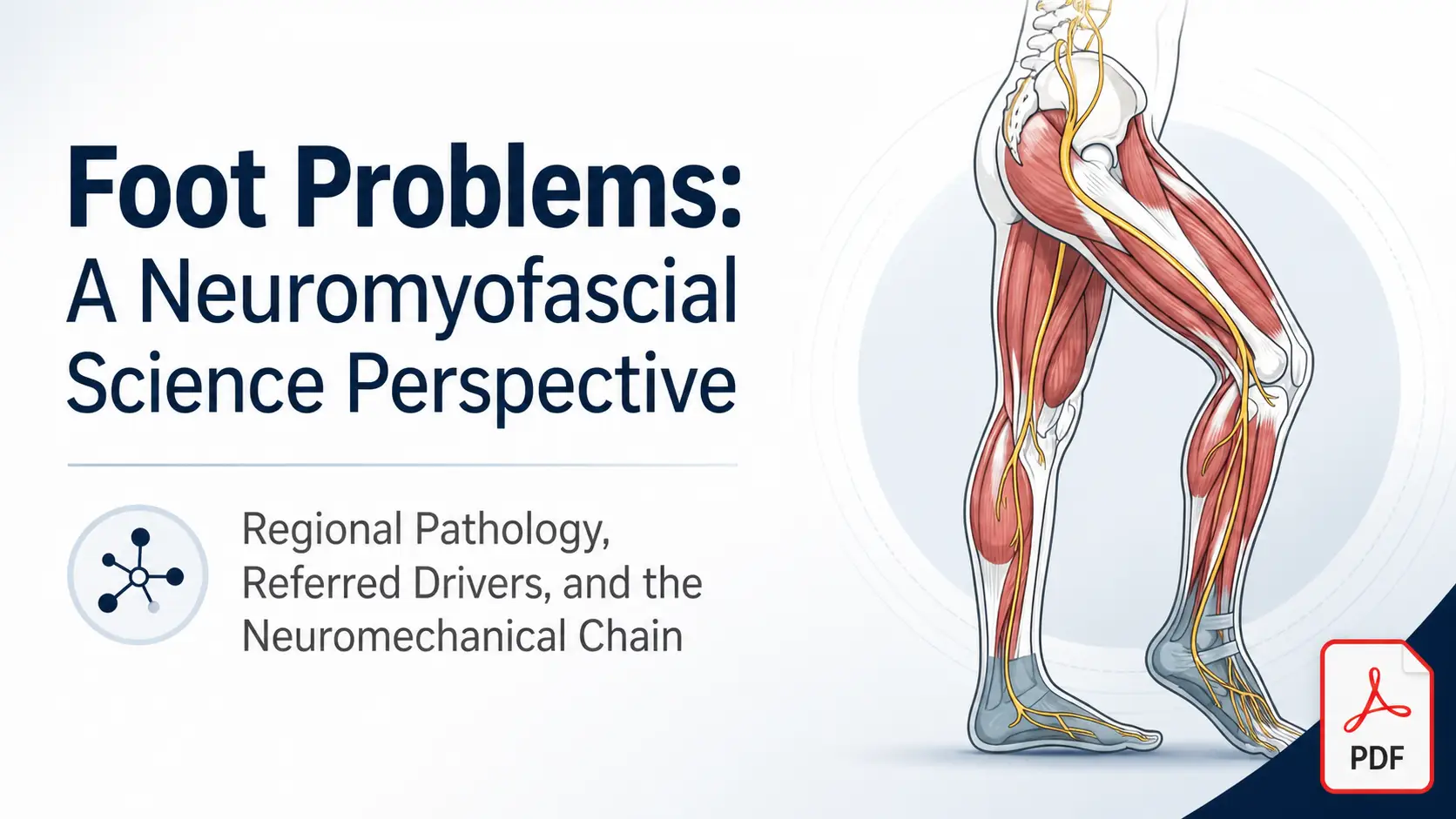
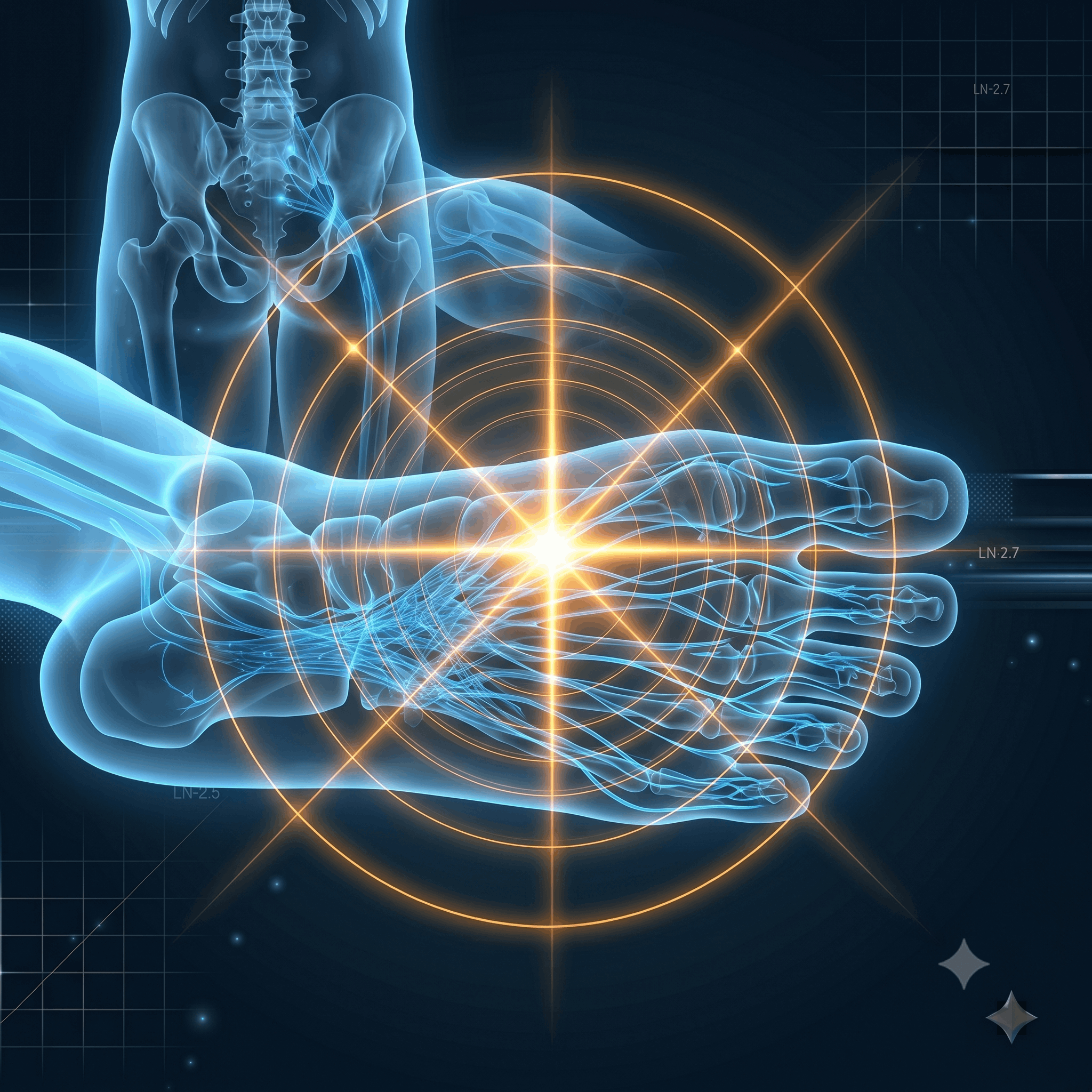
Foot pain is almost always treated as a local problem. The heel, the arch, the tendon, the forefoot. Each gets its own diagnosis and its own local intervention. NMF Science investigates whether some chronic foot conditions may be the visible endpoint of an injury pattern originating higher in the kinetic chain, with the foot absorbing mechanical consequences of dysfunction that local footcare does not reach. Where a spinal contribution is identified and mapped, it may help explain why local treatment sometimes produces only temporary relief.
Current Medical Understanding
Foot conditions are typically diagnosed and treated based on the location of pain. Plantar fasciitis involves heel pain and inflammation of the plantar fascia. Achilles tendinitis involves the back-of-heel tendon. Metatarsalgia involves forefoot pain between the metatarsal bones. Bunions involve progressive big-toe deformity. Morton's neuroma involves nerve swelling between the metatarsal heads. Each of these receives its own local diagnosis and its own local treatment.
Standard interventions focus on the foot and ankle directly. Stretching protocols, custom orthotics, anti-inflammatory medications, corticosteroid injections, night splints, and in chronic cases surgical release or correction are the primary options. Simple acute cases often respond well to this approach. The clinical challenge arises in chronic presentations, where patients have completed multiple rounds of local treatment with only partial or temporary improvement before symptoms return.
Research documents that foot pressure patterns and lower limb loading mechanics are often measurably abnormal in chronic foot pain patients. That finding raises the question of whether the problem extends beyond the foot itself, and whether abnormal mechanics higher up the kinetic chain deserve investigation alongside local care.
NMF Science Perspective
NMF Science does not dismiss the local tissue pathology present in plantar fasciitis, Achilles tendinitis, or metatarsalgia. What it investigates is whether lumbar and sacral nerve root compression or irritation may be an upstream contributor to motor dysfunction that abnormally loads the foot from above.
The kinetic chain from the lumbar spine to the sole of the foot is continuous. The NMF Science hypothesis is that when nerve roots at L5 or S1 are compressed or irritated by fibrosis, disc pathology, or loss of normal lumbar lordosis, the effects may not stay in the lower back. The proposal is that altered signaling travels down the nerve pathway into the calf muscles, producing calf dystonia, a state of chronic involuntary muscle tension. A chronically tightened calf would act as a shortened mechanical pulley, generating sustained upward tension on the Achilles tendon, which transfers through the ankle and concentrates load on the plantar fascia at the heel and arch.
Part of this proposed chain is well supported in the published literature. Gastrocnemius tightness is a recognized association in plantar fasciitis, and one study quantifying the relationship found a strong correlation between the degree of calf tightness and the severity of heel pain (Pearce et al., 2020). Surgical practice reflects similar reasoning: isolated proximal medial gastrocnemius release has been reported for plantar fasciopathy that has not responded to other treatment, addressing the calf rather than the fascia itself (Monteagudo et al., 2018). What the published literature does not establish, and what the NMF Science framework proposes as a hypothesis for investigation, is the upstream question of whether lumbar and sacral nerve involvement contributes to that calf dysfunction in the first place.
In this framework, persistent heel pain in some patients may be less a primary foot problem than the most painful point in a tension pattern established higher up the leg. If that is correct, treating the plantar fascia without addressing calf dystonia and its spinal contribution would leave the force generator active, which could explain why relief is sometimes temporary.
The framework proposes a related mechanism for forefoot conditions. Lumbar nerve root irritation may produce dystonia in specific foot and shin muscles including the tibialis anterior, altering how weight is distributed across the metatarsal heads. Chronic asymmetrical loading could compress the digital nerves and increase metatarsal stress over time. Bunions have well-documented multifactorial contributors including genetics, footwear, and first-ray mechanics. The NMF Science proposal is that altered motor control and loading patterns may be one additional contributor worth assessing, not that the spine explains bunion formation. Morton's neuroma may in some cases represent a late stage of chronic forefoot nerve irritation, and whether upstream motor dysfunction contributes to that process is an open question.
Clinical observations from Dr. Lamb's practice also raise the question of whether spinal pathology at levels above the lumbar spine can contribute to foot symptoms in some patients with chronic, treatment-resistant presentations. This is presented as a clinical observation that warrants further investigation rather than an established finding, and it is one reason the investigational framework considers the full kinetic chain rather than defaulting to the most distal symptomatic site.
This does not mean local foot pathology is not real or that local treatment has no value. It means that in cases of chronic, treatment-resistant foot pain, the lumbar and sacral spine may deserve investigation as potential contributors that local footcare does not reach.
References
Pearce CJ, Seow D, Lau BP. Correlation between gastrocnemius tightness and heel pain severity in plantar fasciitis. Foot Ankle Int. 2021;42(1):76-82. https://pubmed.ncbi.nlm.nih.gov/32924578/
Monteagudo M, Martinez de Albornoz P, Gutierrez B, Tabuenca J, Alvarez I. Plantar fasciopathy: a current concepts review. EFORT Open Rev. 2018;3(8):485-493. https://pubmed.ncbi.nlm.nih.gov/30237906/
When the Foot Is the Endpoint, Not the Origin
One pattern observed in chronic foot pain is the presence of lower back stiffness, hip weakness, or calf tightness that predates or accompanies the foot symptoms. Patients often describe a gradual onset without a clear foot injury, or a history of lower back problems that they never connected to their heel pain. The NMF Science proposal is that this connection may be mechanically direct rather than incidental.
The lumbar spine and pelvis function as a primary mechanical driver of the lower limb system. Where spinal motor control is compromised by nerve root irritation, leg muscles may lose precise neurological signaling, with downstream effects including altered gait mechanics, calf weakness or dystonia, reduced hip stability, and compensatory weight distribution that concentrates force at the foot. Electromyographic changes in lower limb muscles are recognized findings in chronic lumbar radiculopathy, which supports assessing motor function rather than assuming the foot is the sole source.
In this model, the foot may act as the final localized shock absorber for a system that has lost mechanical integrity higher up. Treating only the shock absorber while dysfunction above it remains active is one possible explanation for the cycle of temporary relief followed by recurrence. Mapping the full kinetic chain from the lumbar spine through the pelvis, hip, calf, ankle, and into the foot is what the neuromyofascial investigational process is designed to do.
What We Investigate
→ Lumbar and sacral nerve root compression or irritation at L5-S1 levels and whether fibrosis, disc pathology, or loss of lumbar lordosis may be contributing to downstream calf and foot dysfunction.
→ Calf muscle motor function: whether the gastrocnemius and soleus show signs of dystonia, weakness, or abnormal hypertonicity consistent with L5-S1 nerve root involvement.
→ Achilles tendon loading: whether chronic calf dystonia is generating sustained upward tension on the Achilles tendon and increasing load on the plantar fascia at the heel.
→ Hip and gluteal weakness: whether reduced hip stability and gluteal motor control are contributing to compensatory weight distribution that concentrates mechanical load on the foot.
→ Gait mechanics and foot loading patterns: whether abnormal weight distribution across the heel, arch, or forefoot correlates with upstream motor dysfunction rather than primary foot pathology.
→ Shin muscle dystonia including tibialis anterior involvement and whether this may be contributing to altered forefoot loading or metatarsal stress.
→ Morton's neuroma location and whether it correlates with specific nerve root levels, and whether chronic nerve irritation from upstream factors may be contributing.
→ Myofascial trigger points in the plantar fascia, calf, and forefoot and whether these are amplifying an upstream tension pattern rather than acting as primary sources of pain.
→ Whether spinal pathology above the lumbar levels may be contributing to otherwise unexplained chronic foot pain that has not responded to local treatment.
→ Treatment response patterns: whether addressing lumbar neuromyofascial dysfunction produces measurable improvement in calf tone, gait mechanics, and foot pain, and what that response suggests about the spinal contribution to the kinetic chain map.
Learn More About Foot Pain
Below you will find our most comprehensive educational resources on foot pain and the NMF Science investigational perspective. Explore detailed video explanations, clinical slideshows, and in-depth articles examining how lumbar and sacral nerve root involvement may contribute to kinetic chain dysfunction in chronic heel pain, Achilles tendinitis, metatarsalgia, and related foot conditions.
Videos
Slideshows