One of the more consistent diagnostic patterns in complex chronic pain practice is the patient who presents with significant and persistent symptoms following a whiplash event, whose imaging returns near-normal, and whose physical examination shows little of the expected injury signs. No significant loss of range of motion. No neurological findings that clearly explain the severity of what they are experiencing.
In a proportion of these patients, the explanation is hypermobility.
Who Hypermobile Patients Are
Hypermobility refers to a constitutional tendency toward greater than normal joint and soft tissue laxity. The 2017 international EDS classification describes hypermobile Ehlers-Danlos syndrome and related hypermobility spectrum disorders as heritable connective tissue conditions characterized by joint hypermobility, skin hyperextensibility, and tissue fragility, with persistent pain and joint instability as hallmark clinical features.
In clinical practice, hypermobile patients present with a recognizable set of features. They commonly have a history of natural flexibility from childhood, often having performed dance, ballet, gymnastics, or other activities that rewarded their unusual range of motion. They may have been the child who could do the splits effortlessly, or the gymnast who seemed to move differently from their peers. Their skin often has a softer, more elastic quality than average. Their joints are prone to subluxation and dislocation with relatively minor provocation, and many carry histories of recurring ankle sprains, shoulder instability, or joint injuries that seemed disproportionate to the force involved.
The symptom burden in this population is substantial. Teran-Wodzinski and Kumar (2023) surveyed 396 people with hypermobile Ehlers-Danlos syndrome or generalized hypermobility spectrum disorder. Ninety-eight percent reported pain, with the neck the most commonly affected site at 76 percent, followed by the lower and upper back. Around 80 percent reported fatigue, joint instability, muscle weakness, and interference with daily activities, and roughly 60 percent reported balance problems and reduced joint proprioception. The authors concluded that this population needs a better diagnostic process and improved education among health care providers.
In my practice, hypermobile patients represent approximately 30 percent of the complex chronic pain group. This is a clinical observation from my patient population and does not reflect published population prevalence figures, which vary considerably depending on the diagnostic criteria and population studied. Symptomatic care-seeking cohorts in this category are often female-predominant, and research suggests hormonal factors influence ligament laxity and pain presentation, though the degree of sex difference in baseline constitutional hypermobility varies across studies.
Why Hypermobility Creates a Diagnostic Problem
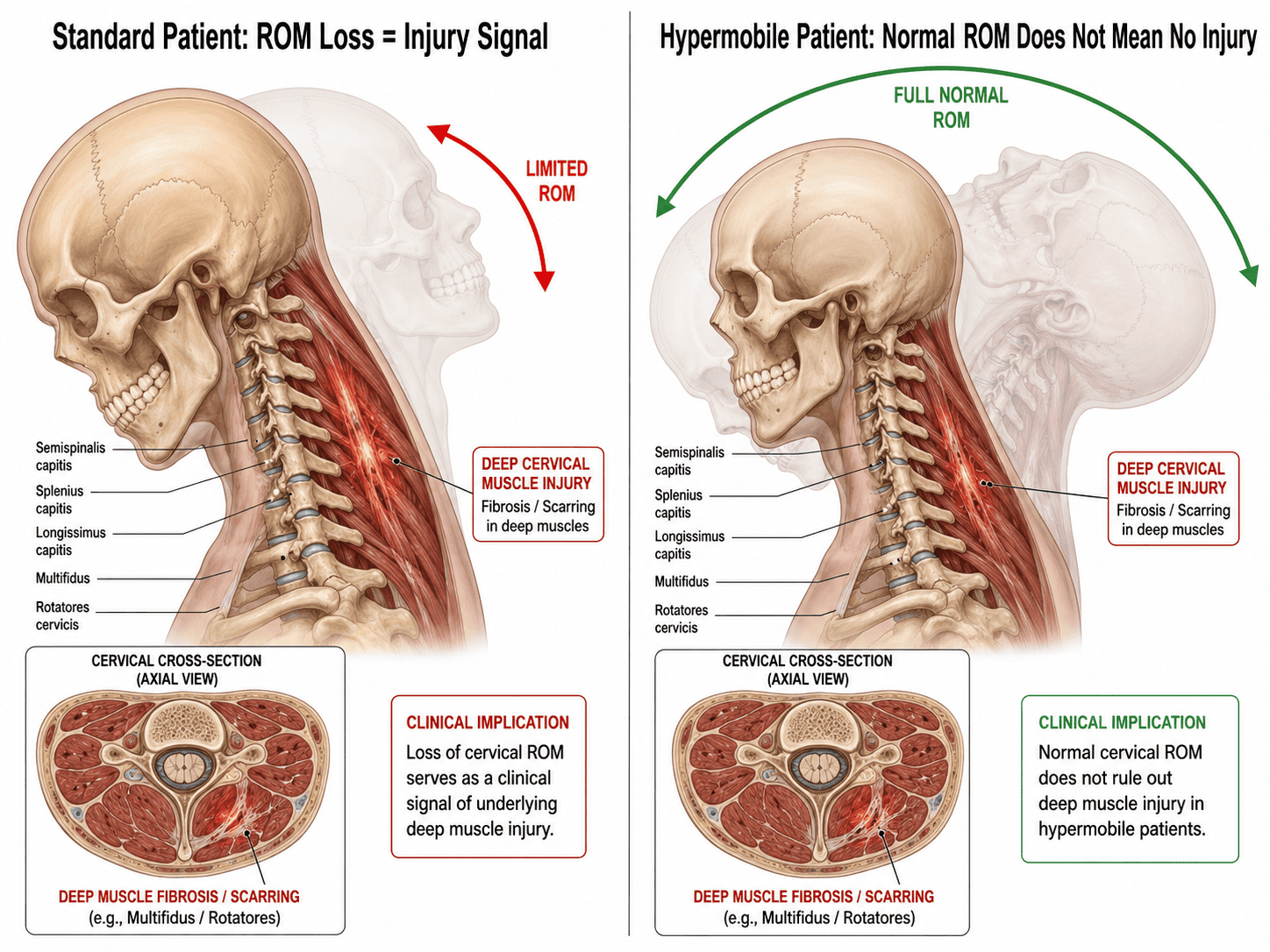
Standard clinical assessment of spinal injury relies heavily on range of motion. A cervical spine that moves freely and fully through its range is generally assumed to be healthy or minimally injured. Loss of range of motion is treated as a primary indicator of injury severity.
This logic fails in hypermobile patients for a straightforward reason: their baseline range of motion is above normal. A hypermobile individual who has sustained a significant whiplash injury may still demonstrate range of motion that appears normal or even above normal to a clinician who does not know their pre-injury baseline. The injury is present and clinically significant, but the range of motion sign that would flag it in a non-hypermobile patient is absent.
A 2022 cross-sectional study published in PeerJ found that hypermobile individuals with nonspecific neck pain had worse cervical joint-position error and lower neck muscle endurance than hypermobile individuals without neck pain, and that higher hypermobility scores tracked with greater cervical position-sense deficit and lower endurance. This supports the broader clinical premise that hypermobility alters cervical stability, proprioception, and pain presentation in ways that standard examination may not capture.
The problem compounds on imaging. The loose joint structure of hypermobile individuals means spinal segments move through a greater arc during a whiplash event. The resulting soft tissue injuries may not produce the disc or bony changes that standard MRI protocols are designed to detect. A systematic review and meta-analysis in the Journal of Magnetic Resonance Imaging concluded that the clinical significance of many cervical MRI findings in whiplash remains uncertain, and that near-normal MRI cannot be treated as a reliable rule-out for clinically important post-whiplash pathology.
What Emerging Research Shows About Occult Nerve Involvement
An important and growing area of whiplash research supports the idea that some patients classified under standard grading systems as having no apparent neurological injury may still have meaningful nerve involvement that standard bedside testing does not detect.
Ridehalgh and colleagues (2025) studied 122 people within four weeks of a whiplash injury, all classified as WAD grade II, meaning neck complaints and musculoskeletal signs without frank neurological signs, and compared them with 43 healthy controls. Magnetic resonance imaging showed increased T2 signal in the C5 root of the brachial plexus and in the C5 to C8 dorsal root ganglia in the whiplash group. Fifty-five percent showed signs of heightened nerve mechanosensitivity, 47 percent had somatosensory changes on quantitative sensory testing, and inflammatory mediators were raised compared with controls. The authors concluded that their results provide evidence suggestive of peripheral neuroinflammation in a subgroup of these patients, and that there is a need to reconsider how WAD II is managed.
A follow-up study from the same group tracked 62 of those participants to six months. Only 32 percent considered themselves fully recovered. The T2 signal changes in the nerve roots and dorsal root ganglia were essentially unchanged from the acute assessment, while signs of nerve mechanosensitivity and upper limb hyperalgesia improved. The authors concluded that peripheral neuroinflammation may persist in some individuals well beyond the acute phase.
These findings matter for the hypermobile patient specifically. A presentation with preserved or excessive range of motion and limited standard examination findings is exactly what places someone in a lower-grade WAD classification, which in turn prompts less thorough neurological investigation. That is the population in which nerve involvement of this kind is most likely to go unexamined.
Spinal Myelopathic Syndrome in Hypermobile Patients
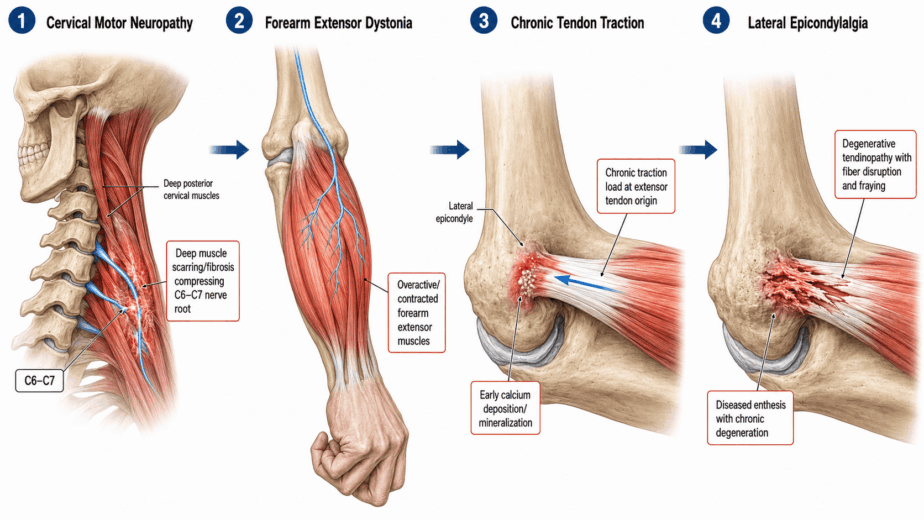
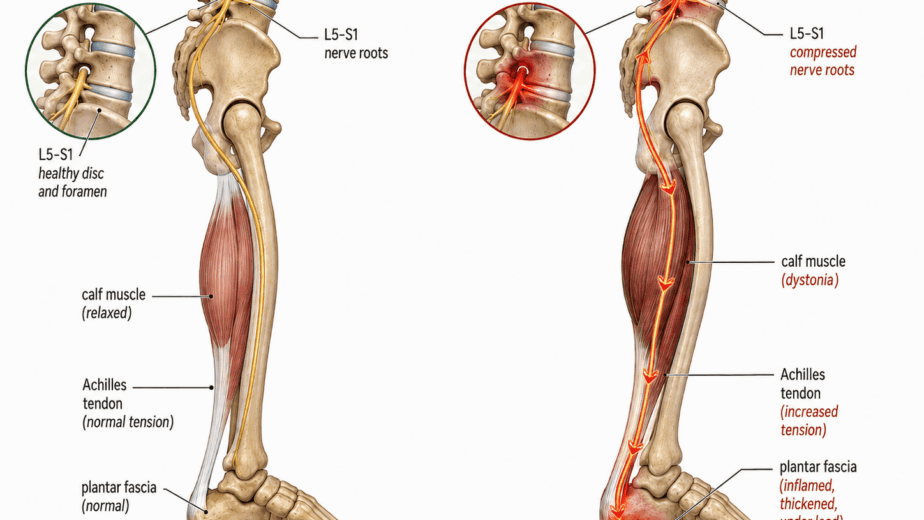
After a significant whiplash event, hypermobile patients may be at elevated risk of developing what I describe as Spinal Myelopathic Syndrome, or SMS. This is a clinical framework I use to describe injury and functional compromise at or near the level of the spinal cord, producing a symptom pattern that resembles post-concussion syndrome: widespread body aches, arm and leg symptoms, fatigue, cognitive changes, and sensory disturbances, without obvious trigger or significant range of motion loss on examination.
SMS as a named syndrome is not currently validated in the indexed literature, and I present it as a clinical observation framework rather than an established diagnosis. What the emerging research does support is that nerve involvement can be present in patients who would traditionally be classified as having no neurological injury, and that it can persist for months. Whether structures at or near the spinal cord are involved in a subgroup of these patients is a further question that the current evidence does not settle.
In hypermobile patients, the mechanics of the injury pattern mean that spinal segments move through a greater arc during trauma, and the proposal is that stabilizing tissue forming in response may develop in positions that create different alignment and tension patterns than in a non-hypermobile individual. This is a clinical hypothesis grounded in observation and in the emerging nerve-pathology literature. It warrants dedicated research.
What Assessment Should Include
Every assessment of a patient with chronic pain following whiplash should include a hypermobility evaluation as a standard component. The Beighton score remains the standard screening tool for generalized joint hypermobility, and research supports its clinical utility when hypermobility is suspected. This is not currently routine in most clinical settings, and that gap likely contributes to the underdiagnosis of this patient group.
When hypermobility is identified, range of motion findings should be interpreted against the patient’s expected hypermobile baseline rather than against population norms. A cervical spine that demonstrates full range of motion in a hypermobile patient after whiplash is not necessarily a reassuring finding. It may be a marker of an injury pattern that standard assessment tools are not designed to detect.
If a hypermobile patient shows significant loss of range of motion following whiplash, that finding warrants particular attention, precisely because their expected baseline mobility is higher than average. Restricted range of motion in a constitutionally hypermobile patient may indicate a degree of structural compromise that would generate far greater restriction in a non-hypermobile individual.
The assessment in these patients should also include attention to sensorimotor features, upper cervical stability, autonomic symptoms, and neuropathic pain characteristics, particularly when symptoms are disproportionate to standard examination findings. The emerging WAD literature suggests these features may be present in patients whose classification would not traditionally prompt that level of investigation.
Hypermobility does not protect against whiplash injury. In clinical observation, it may increase the risk of serious spinal injury being missed.
The information in this article is educational and informational in nature. It is not intended as a substitute for professional medical advice, diagnosis, or treatment. If you are experiencing chronic pain following a whiplash injury and have a history of joint hypermobility, consult with a qualified healthcare provider to discuss appropriate assessment and care.