Skip to contentSkip to sidebarSkip to footer
Neuromyofascial Science
Menu Close
  • HOME
  • CONDITIONS
    • MS
    • Fibromyalgia
    • Post-Concussion
    • TMJ & Tinnitus
    • Migraines
    • Elbow Pain
    • Foot Pain
    • Sciatica
  • PATIENTS
    • Browse All Conditions
    • Patient Success Stories
    • Latest Videos
  • CLINICAL RESOURCES
  • COLLABORATE
  • ABOUT
    • NMF Science Education
    • TNPC Treatment Info
    • NMF team
Close
  • HOME
  • CONDITIONS
    • MS
    • Fibromyalgia
    • Post-Concussion
    • TMJ & Tinnitus
    • Migraines
    • Elbow Pain
    • Foot Pain
    • Sciatica
  • PATIENTS
    • Browse All Conditions
    • Patient Success Stories
    • Latest Videos
  • CLINICAL RESOURCES
  • COLLABORATE
  • ABOUT
    • NMF Science Education
    • TNPC Treatment Info
    • NMF team
Neuromyofascial Science
  • Home
    • Hospital
      Doctor
      Medical Center
      Private Clinic
      Medical Lab
      Dentist
  • Pages
    • About Us
    • Our Mission
    • Services
    • Departments
    • Our Doctors
    • FAQ
    • Patient Success Stories
    • Pricing
    • Locations
    • 404 Page
    • Service Plus
    • AI Features
  • Services
    • About Us

      Learn about our hospital and values

      Services

      Explore our wide range of medical services

      Departments

      Discover our specialized medical departments

      Blog

      Get the latest health news and tips

      Contacts

      Contact us for appointments or inquiries

      Testimonials

      Read patient stories and feedback

  • Blog
    • Blog – Standard
    • Blog – Grid
  • Contact Us
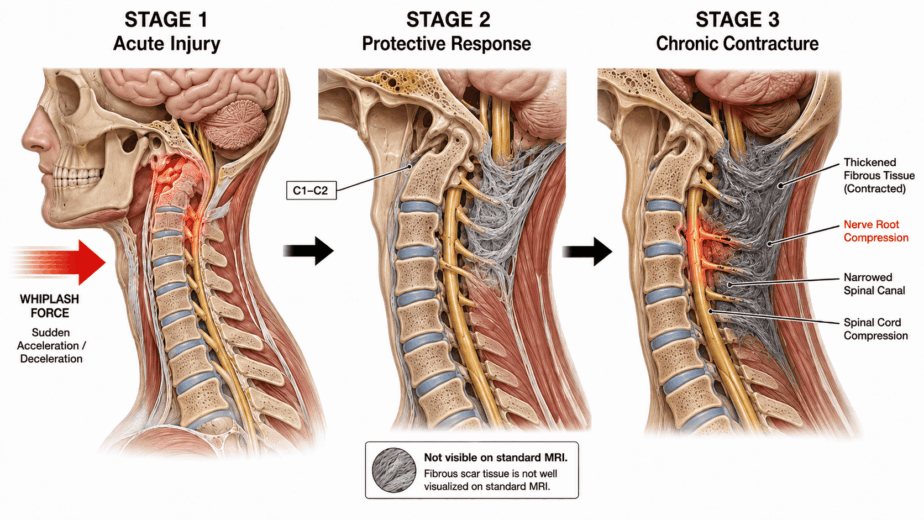
Three-stage medical illustration showing the evolutionary injury response following whiplash. Stage 1 shows acute whiplash force hitting the cervical spine with immediate injury at the upper cervical region. Stage 2 shows fibrous protective tissue forming at C1-C2, labeled as not visible on standard MRI. Stage 3 shows chronic contracture with thickened fibrous tissue, nerve root compression in red, narrowed spinal canal, and spinal cord compression.
Injury and Recovery, NMF Science Explained

Super Contractures: The Invisible Aftermath of Spinal Injury

3 days ago0Comments
When a spinal injury heals, most people assume the tissue returns to something close to its original state. Scar forms, the acute phase resolves, and…
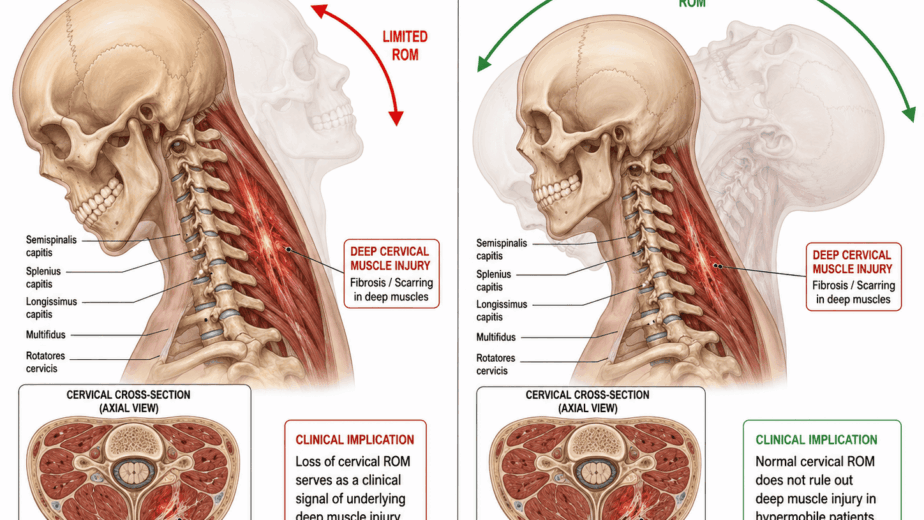
Split anatomical illustration comparing standard patient and hypermobile patient cervical spine assessment. Left panel shows limited ROM arc in red with deep cervical muscle fibrosis and scarring visible in axial cross-section, with clinical implication that ROM loss signals underlying injury. Right panel shows full normal ROM arc in green with identical deep muscle fibrosis present, with clinical implication that normal ROM does not rule out deep muscle injury in hypermobile patients.
Conditions, NMF Science Explained

Hypermobility and Whiplash: Why Flexibility Can Hide Serious Spinal Injury

3 days ago0Comments
One of the more consistent diagnostic patterns in complex chronic pain practice is the patient who presents with significant and persistent symptoms following a whiplash…
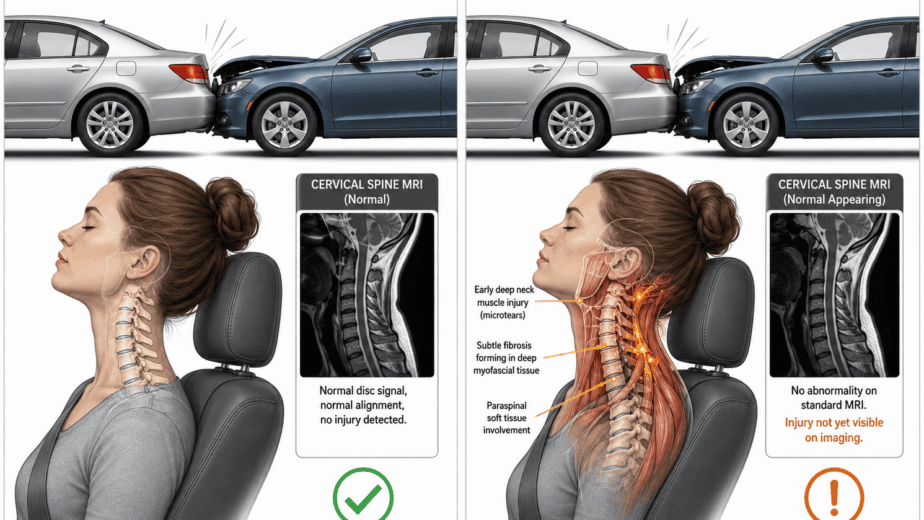
Split clinical illustration comparing standard WAD 1 assessment and neuromyofascial assessment of the same rear-end collision. Left panel shows normal cervical MRI with green checkmark and no injury detected. Right panel shows the same normal-appearing MRI but with deep neck muscle microtears, early fibrosis, and paraspinal soft tissue involvement highlighted in orange, with the notation that injury is present but not yet visible on imaging.
Conditions, NMF Science Explained

Why the WAD Classification Fails Whiplash Patients

4 days ago0Comments
Whiplash is one of the most common injury mechanisms in modern medicine and one of the most poorly managed. Part of the reason is clinical.…
NMF Science Explained

Why I Built a Framework That Medicine Didn’t Have

June 5, 20260Comments
Most of what I know about chronic spinal pain, I first learned from my own body. In 1992, I sustained complex spinal injuries from a…
NMF Science Explained, Research and Clinical Insights

When the MRI Says Normal But the Pain Says Otherwise

June 5, 20260Comments
One of the most frustrating experiences in medicine is a patient who has been in significant pain for months or years, has undergone every standard…

Search
Categories
  • Conditions
  • NMF Science Explained
  • Injury and Recovery
  • Performance and Sport
  • Research and Clinical Insights
Recent Posts
Super Contractures: The Invisible Aftermath of Spinal Injury
Injury and Recovery, NMF Science Explained
Super Contractures: The Invisible Aftermath of Spinal Injury
June 9, 2026
Why Athletes Keep Getting Re-Injured: The Spinal Origin of Tendinopathy
Conditions, Performance and Sport
Why Athletes Keep Getting Re-Injured: The Spinal Origin of Tendinopathy
June 9, 2026
Neuromyofascial Science

Neuromyofascial Science is a precision-based clinical framework that maps the specific anatomical sources of chronic pain, neurological dysfunction, and structural pathology. Developed by Dr. G. Blair Lamb over 30 years of clinical innovation, NMFS uses a comprehensive neuromyofascial audit to build a patient-specific map of injury patterns and structural drivers, giving patients and their care teams a more precise picture of what is actually driving their condition.

Links
  • Home
  • Conditions
  • Patient Stories
  • Clinical Resources
  • Collaborate
Get in Touch
X-twitter Youtube Instagram Linkedin Tiktok

© 2026. All Rights Reserved.

Site by Neuromyofascial Science