Post-concussion syndrome is one of the more poorly understood conditions in medicine. Patients present with headaches, dizziness, tinnitus, brain fog, light sensitivity, and fatigue. Imaging comes back normal. The diagnosis is brain-centered, yet many of the rehabilitation approaches that help these patients are directed at the neck, spine, and vestibular system.
That paradox is not a coincidence, and it is not a fringe observation. It reflects something the research literature has been documenting for more than a decade: in many cases, what is labeled post-concussion syndrome has a substantial spinal component.
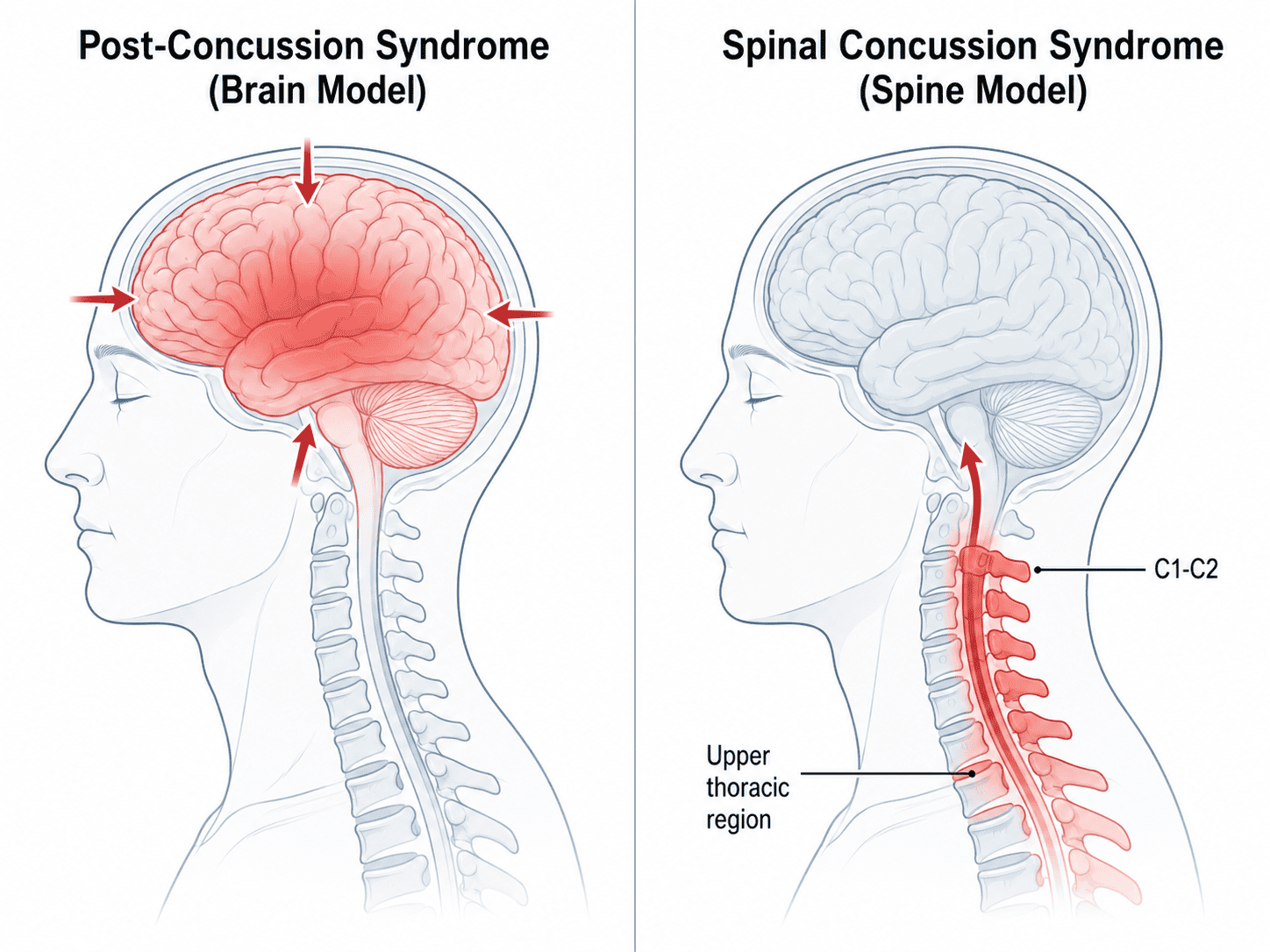
I introduced the term Spinal Concussion Syndrome, or SCS, to name and describe that contribution. This article sets out what the published evidence establishes about the cervical spine in persistent post-concussion symptoms, and where the SCS model goes further than the evidence currently supports.
What the Brain-Only Model Misses
The standard model treats the brain as the primary injury site. A concussive event occurs, the brain is assumed to be the damaged tissue, and treatment follows: cognitive therapy, rest, medication, symptom management.
That model works reasonably well for many patients. For others it does not, and one reason is straightforward. A concussive event is rarely a brain-only event. When the head undergoes acceleration-deceleration forces, whether from a motor vehicle accident, a contact sport impact, a fall, or a direct blow, the cervical spine absorbs a significant portion of that force. The neck and the head move together. They are injured together.
Three clinical patterns make this harder to explain on a brain-injury model alone. Symptom severity frequently does not track the force of the original impact, with minor impacts sometimes producing severe persistent symptoms. Some patients develop post-concussion symptoms after acceleration-deceleration injuries with no direct head strike. And symptoms sometimes worsen or emerge weeks or months after the event rather than improving from an early peak.
None of those observations proves a spinal origin. Each is consistent with one, and each is a reason to examine the neck rather than assume it is uninvolved.
What the Evidence Actually Shows
The strongest evidence here is not observational. It is a randomized controlled trial.
Schneider and colleagues randomized patients aged 12 to 30 with persistent dizziness, neck pain, or headaches following sport-related concussion into two groups. Both received postural education, range of motion exercises, rest until asymptomatic, and a graded exertion protocol. The intervention group additionally received cervical spine and vestibular rehabilitation. The outcome was medical clearance to return to sport, assessed by a physician blinded to group allocation.
In the treatment group, 73 percent were medically cleared within eight weeks. In the control group, 7 percent were. Participants receiving cervical and vestibular treatment were 3.91 times more likely to be cleared by eight weeks.
That is a striking result from a small trial, and it establishes something important: adding treatment directed at the neck to standard concussion care changed how quickly patients recovered enough to return to sport. The trial does not isolate which component did the work, since cervical and vestibular rehabilitation were delivered together.
A second study addresses the identification question. Kennedy and colleagues reviewed 46 patients with persistent post-concussion symptoms who had been referred for cervical spine assessment. Thirty-two were found to have a cervicogenic component and 14 were not. The distinguishing factor was physical examination findings, particularly pain on manual segmental examination of the cervical spine. Among those treated for the cervicogenic component, function improved by a mean of 3.8 points on the patient-specific functional scale and pain decreased by a mean of 4.6 points on the numeric rating scale.
The authors concluded that their findings give preliminary support to the idea that the cervical spine may contribute to persistent post-concussion symptoms, and highlight the value of assessing and treating it after concussive injury.
Two points in that study deserve emphasis. First, roughly two thirds of this referred group had an identifiable cervicogenic component, which is not a rare subgroup. Second, it was identified by hands-on examination rather than by imaging. A patient whose MRI is normal has not been shown to have an uninvolved neck. They have been shown to have a normal MRI.
The Proposed Mechanism
Established evidence shows the cervical spine contributes and that treating it helps. What it does not establish is exactly how. The SCS model offers an account, and it should be read as a hypothesis.
The proposal is that when the spine experiences trauma, the body forms dense scar-like neuromyofascial tissue around the injured area. In the short term this is protective, stabilizing the region like an internal brace. Over time that tissue may become pathological, restricting normal spinal movement and beginning to tether the spinal cord, which normally glides freely within the canal during movement.
Where the cord cannot glide, the hypothesis is that movement generates tension transmitted upward toward the brainstem, cranial nerves, and optic nerve. That would offer one explanation for how a spinal injury produces symptoms resembling brain injury: headaches at specific locations, vestibular disruption, visual disturbance and light sensitivity, tinnitus, cognitive changes, fatigue, mood changes, and autonomic symptoms.
The upper cervical region, specifically the atlas-axis junction at C1-C2, is of particular interest in this model. It governs head position and balance mechanics and sits at the transition between spinal cord and brainstem. It is also not evaluated in detail by standard post-concussion protocols.
Spinal cord tethering after concussion has not been demonstrated as a mechanism. It is a clinical hypothesis that would require dedicated imaging and mechanistic research to test.
SCS Does Not Replace PCS
Spinal Concussion Syndrome is not an argument that brain injury never occurs. A patient can have brain injury without significant cervical involvement, cervical involvement without brain injury, or both at once. The clinical picture is often mixed, and the Kennedy data reflects that directly: roughly a third of the patients assessed had no cervicogenic component.
What SCS proposes is that in many cases currently labeled post-concussion syndrome, the spinal contribution is substantial and under-investigated. In those patients, brain-centered treatment alone may produce incomplete results because a real injury site is not being addressed.
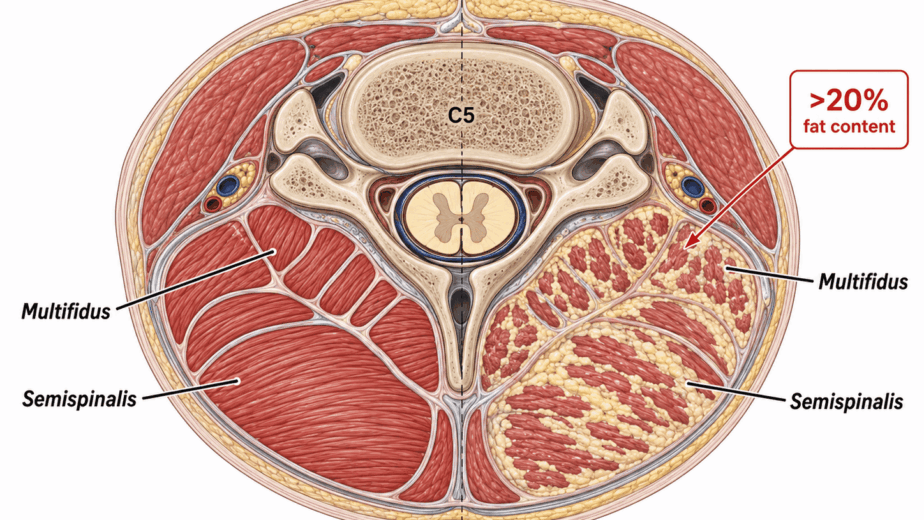
The practical implication is modest and well supported: the cervical spine should be assessed as part of a thorough post-concussion workup rather than assumed normal because imaging is normal. Deep cervical muscle injury and craniocervical soft tissue changes are not reliably visible on standard MRI protocols, and the identification method that worked in the published series was manual examination.
Why Recovery Stalls
Patients who do not recover with standard post-concussion rehabilitation are often told there is nothing more to offer, or that their symptoms reflect anxiety, central sensitization, or lingering neurological effects of the brain injury.
Some of those explanations are correct for some patients. But the trial evidence suggests another possibility worth excluding first: that a treatable cervical contribution is present and has not been examined. A patient who has never had a careful manual assessment of the cervical spine has not exhausted the options.
The neuromyofascial approach is to map the cervical and neuromyofascial findings systematically and direct care at what is identified rather than managing symptoms at the surface. Whether that produces better outcomes than the cervical and vestibular rehabilitation already shown to work in the Schneider trial has not been tested in a controlled comparison. That study would be worth running, and the existing trials make the general direction a reasonable one to pursue.
The brain is not always the whole problem. In a substantial proportion of post-concussion patients, the neck is part of it, and the evidence for examining it is better than most patients are told.
The information in this article is educational and informational in nature. It is not intended as a substitute for professional medical advice, diagnosis, or treatment. If you are experiencing post-concussion symptoms or chronic head and neck pain following an injury, consult with a qualified healthcare provider to discuss the options appropriate for your situation.