When a spinal injury heals, most people assume the tissue returns to something close to its original state. Scar forms, the acute phase resolves, and the body moves on. For a significant number of whiplash patients, that is not what happens. The body’s repair response produces something structurally different from the tissue it replaced, and in some cases, that new tissue may create more problems than the original injury.
Dr. G. Blair Lamb describes this process through the concept of super contractures: dense, organized bands of neuromyofascial scar tissue proposed to form around injured spinal segments in the weeks and months following trauma. Understanding what these are, how they may form, and why standard imaging is not designed to detect them is central to the question of why so many whiplash patients do not recover.
The Evolutionary Injury Response
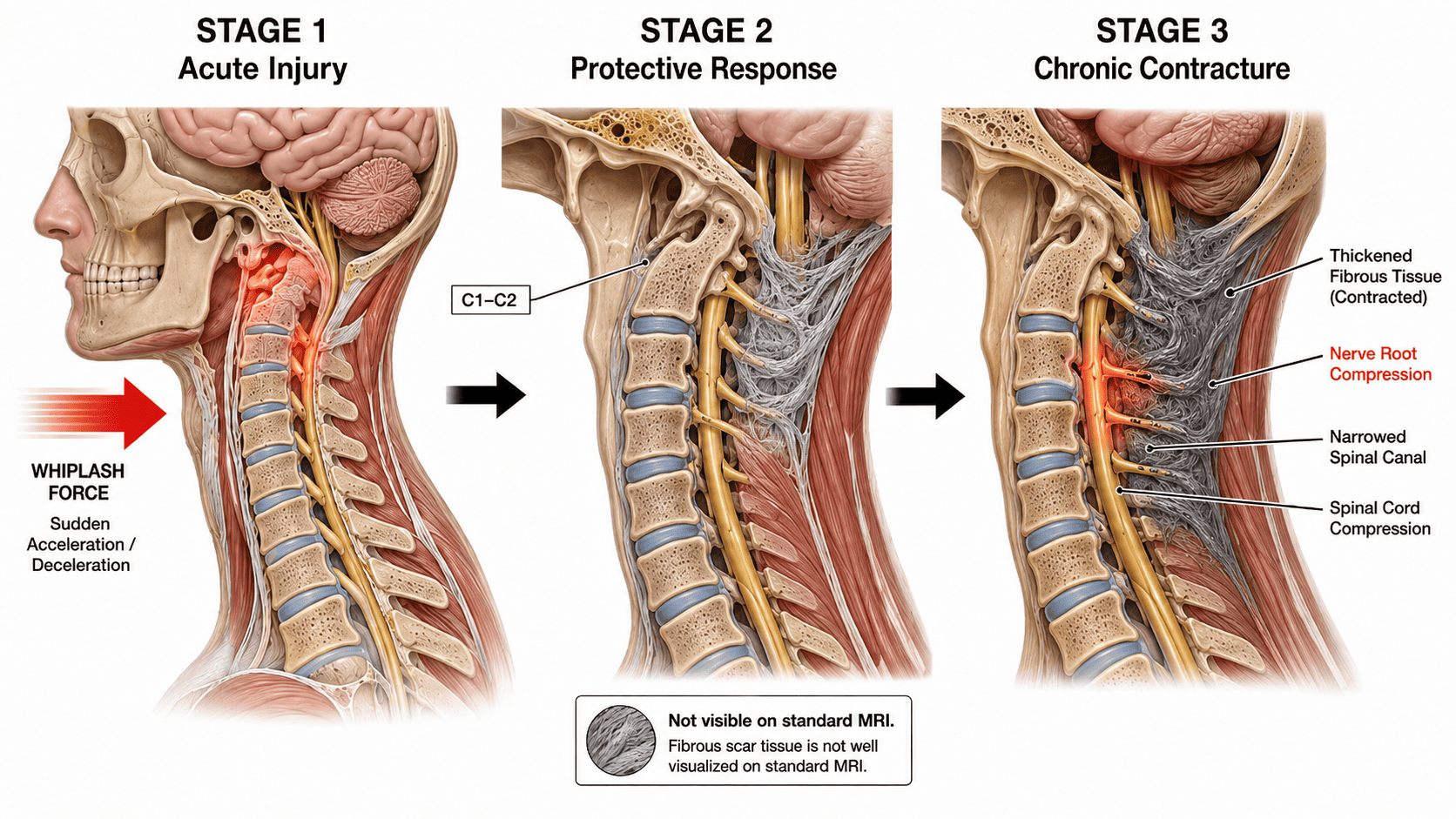
When the spine sustains significant trauma, the body initiates what Dr. Lamb describes as the evolutionary injury response. It is a survival mechanism. The body detects structural instability in the injured region and responds by rapidly forming dense, fibrous stabilizing tissue around the damaged vertebrae and soft tissue. The goal is to create an internal cast, to immobilize the injured segment and prevent further damage.
In an acute setting, this response is protective and appropriate. In the short term, stabilizing a damaged spinal segment through fibrous tissue formation helps prevent the kind of secondary injury that movement through an unstable region could cause.
The problem, in this model, emerges over time. As the stabilizing tissue matures, it may become progressively denser, more disorganized, and more contractile. What began as a protective internal cast is proposed to transition into a pathological structure: tissue that shrinks and tightens, holds spinal vertebrae out of their natural alignment, compresses surrounding nerve roots, and in its most advanced form wraps around the spinal cord itself, restricting the gliding motion the cord depends on during movement.
This is the super contracture: tissue formed to protect the spine that becomes, in this model, a mechanism of chronic injury.
Why Standard Imaging Cannot See It
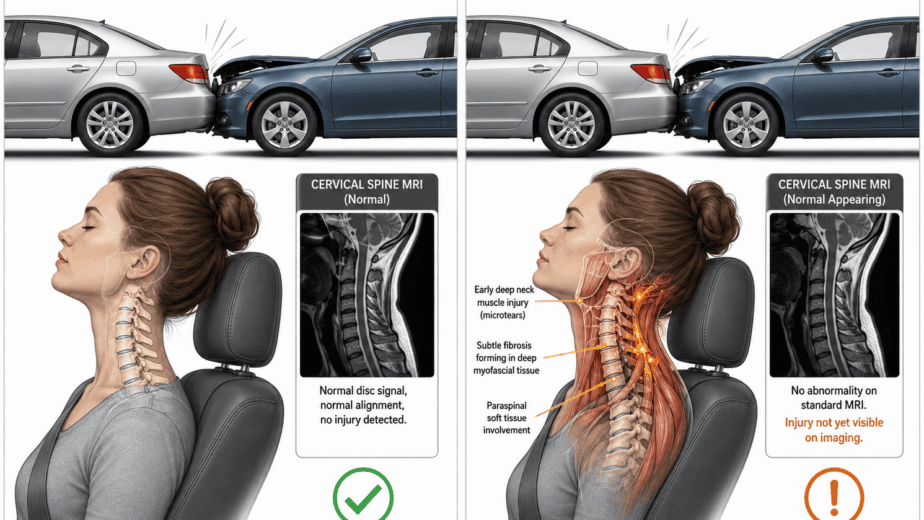
Standard MRI, X-ray, and CT scanning are designed to detect structural abnormalities: fractures, disc herniations, obvious soft tissue masses, gross alignment changes. They are not designed to detect the subtle density changes, fascial contractures, and dynamic restriction patterns that would characterize neuromyofascial super contractures.
The result may be a diagnostic blind spot affecting a substantial number of patients. A whiplash patient undergoes standard imaging, receives a report showing no significant abnormality, and is told their spine is essentially normal. If super contractures are present and contributing to their symptoms, they are invisible to the tools being used to look.
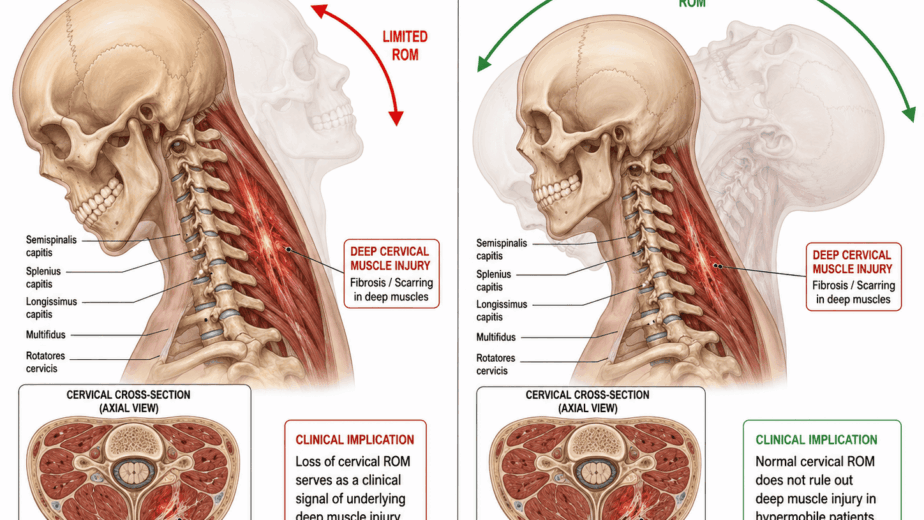
Curatolo and colleagues (2011) addressed this in a review of tissue damage in whiplash-associated disorders. They concluded that lesions of various tissues have been documented in animal, cadaver, and patient studies, that most are undetected by imaging, and that lack of macroscopically identifiable tissue damage does not rule out the presence of painful lesions. The same review is careful about what remains unknown: it states that the proportion of whiplash patients in whom a persistent lesion is the major determinant of ongoing symptoms has not been established, and that psychosocial factors, stress reactions, and generalized hyperalgesia also predict outcomes. Both halves of that conclusion matter. A normal scan does not rule out structural injury, and structural injury is not the whole story for every patient.
This is not a failure of imaging technology for the purposes it was designed for. It is a mismatch between what the technology is built to detect and what may be producing the patient’s symptoms.
Spinal Cord Tethering: When the Cast Becomes a Cage
Normally, the spinal cord glides freely within the spinal canal as the body moves. This gliding motion is essential for normal neurological function. The proposal in this framework is that when dense neuromyofascial scarring accumulates around the cord, it restricts that glide and the cord becomes tethered.
A tethered spinal cord does not simply stay still. It transmits tension. Movement that would normally allow the cord to glide instead generates mechanical tension along its length, and that tension may not stay localized. A tethering point at the upper cervical spine could transmit upward tension into the brainstem and cranial nerves, or pull downward, generating unexplained weakness or heaviness in the legs. In this model, that mechanism may contribute to the persistent headaches, vestibular disruption, visual changes, fatigue, brain fog, and sensory disturbances that whiplash patients describe and that brain-centered assessment does not fully explain.
Research in analogous conditions including adhesive arachnoiditis, tethered cord syndromes, and post-surgical spinal adhesions has documented neurological symptoms including pain, sensory disturbances, weakness, balance dysfunction, and fatigue arising from restricted neural mobility rather than gross compression. The specific mechanism of post-whiplash fibrosis producing spinal cord tethering as described by Dr. Lamb is a clinical hypothesis that warrants dedicated investigation. The biological plausibility of neural tissue becoming mechanically sensitized by adhesions and altered mobility is well established in this broader literature.
This proposed mechanism offers one explanation for why whiplash symptoms sometimes worsen over time rather than improving. If repair tissue forms and matures over the following weeks, months, and years, tightening as it does so, the symptom picture could worsen well after the injury event. The patient deteriorates years after a collision, and the connection between the two is missed because no one is examining what the repair process left behind.
Elliott and colleagues (2011) followed 44 patients after whiplash injury and found that muscle fat infiltration in the cervical extensors increased over six months in the group with moderate to severe disability, while remaining unchanged in those who recovered. A larger prospective study by Smith, Elliott and colleagues (2020) confirmed the pattern at twelve months, with infiltration concentrated in the medial portions of the deep cervical extensors and significantly greater in patients with severe chronic symptoms.
One finding from the 2011 study deserves attention because it complicates a purely mechanical account: initial post-traumatic stress symptom severity mediated the relationship between pain intensity and muscle fat infiltration, while initial range of motion loss did not. Tissue change after whiplash appears to be real, measurable, and progressive in patients who do not recover, and it also appears to interact with the stress response to the injury. Any complete model of why some patients deteriorate has to account for both.
The Kinetic Energy Factor
Dr. Lamb has noted, as discussed in the physics of whiplash, that the forces involved in motor vehicle accidents are routinely underestimated by patients, clinicians, and insurers alike. Kinetic energy rises with the square of the change in speed, which means modest increases in impact speed involve substantially larger forces. Even residential speed impacts involve forces the human body was not designed to absorb without tissue effect.
Siegmund and colleagues (2000) tested human cervical motion segments under combined posterior shear, extension, and axial compression and measured strain in the facet capsular ligaments. Their results suggest that these ligaments may be injured under load levels that occur in rear-end impacts. This is a biomechanical parallel to the broader neuromyofascial argument: meaningful tissue injury may occur at force levels that leave little obvious trace.
The proposal in this framework is that the severity of the super contracture response relates to the force absorbed by the spine, with higher-force injuries producing more extensive scarring, greater contracture density, and more significant tethering. That may be one reason some patients involved in apparently minor accidents develop severe chronic pain while others recover, alongside the pre-existing condition of the spinal tissues and individual variation in how the repair process organizes.
The Diagnostic Gap and What Follows It
When a patient with persistent pain receives a normal MRI result, the clinical pathway often moves toward symptom management rather than further structural investigation. That is a reasonable response to the information available. The concern is what happens when a structural contributor is present but has not been identified by the tools used to look for it.
Persistent symptoms after whiplash are common. A substantial proportion of patients report ongoing symptoms months to years after the initial injury, and a smaller but significant group experience moderate to severe chronic pain and disability. For those patients, the question of whether anything remains unexamined is worth asking.
Chronic pain that is poorly explained and poorly relieved is a difficult clinical situation for patients and physicians alike, and it is one of the reasons accurate diagnosis matters. The NMF Science position is not that neuromyofascial assessment resolves that difficulty, or that it addresses any broader public health problem. It is narrower: that where a structural contributor is present and unidentified, finding it is worth the effort, and that the tools to look for it deserve development and study.
What This Means for Patients
Patients who have been told their imaging is normal following a whiplash injury, who continue to experience pain and neurological symptoms that do not respond to standard rehabilitation, and who have been offered only symptom management deserve a different question: what did the injury leave behind that standard imaging is not designed to see?
The super contracture model offers one mechanistically coherent answer. Protective tissue forms after injury. That tissue matures into a structure that may itself generate symptoms. Identifying it, mapping it, and addressing it directly is the approach this framework proposes, and whether that produces better outcomes than symptom management is a question that requires formal study.
The biological concepts underlying this model are supported by a growing body of peer-reviewed evidence. The specific terminology and the full causal chain as Dr. Lamb describes it remain investigational. That is not a reason to dismiss the framework. It is a reason to investigate it.
This article draws on the clinical framework of Dr. G. Blair Lamb and is intended for educational purposes. It is not a substitute for professional medical advice, diagnosis, or treatment. If you are experiencing chronic symptoms following a whiplash injury that have not responded to standard care, consult with a qualified healthcare provider.